DeepSeek vs GPT vs Gemini vs Claude: Token Price Comparison for Indian Developers (2026)

Praveen Kumar
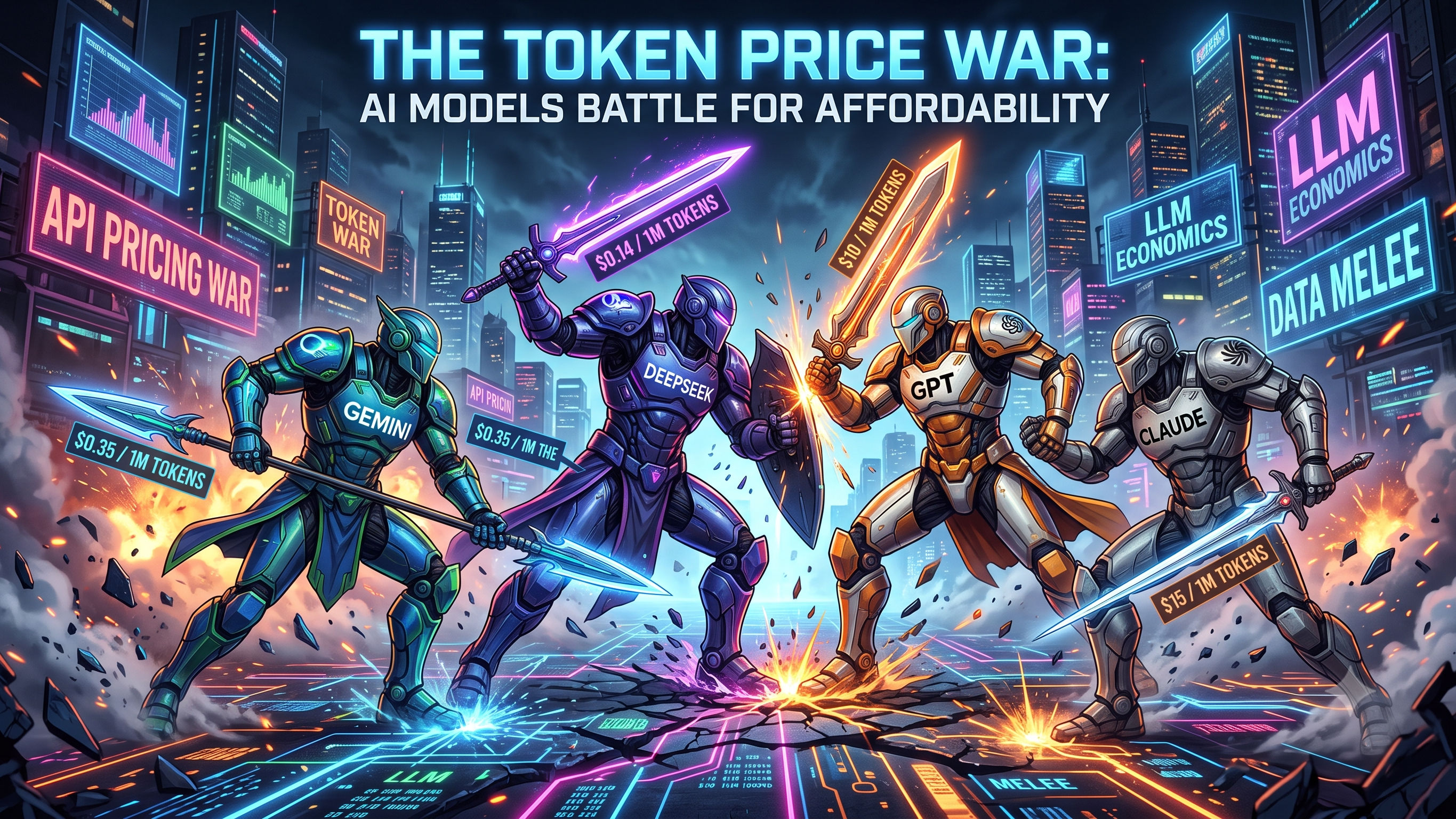
What Is a Token and Why Does Pricing Work This Way?
Before the comparison, the basics: AI models do not process words — they process tokens. One token is roughly 0.75 English words. "I am building a web app" is approximately 7 tokens. Every word you send to the model (input) and every word it writes back (output) is billed separately.
All prices are in USD per 1,000,000 tokens. There are no monthly subscriptions on the API and no per-seat fees. You pay exactly for what you use — which is why knowing the input and output price separately matters so much. Output tokens are almost always more expensive than input tokens, sometimes 2x to 10x more.
At scale, this math multiplies fast. A chatbot handling 10,000 conversations per day, each with 500 input tokens and 300 output tokens, processes 8 million tokens daily — roughly 240 million tokens per month.
2026 Token Pricing: The Complete Comparison Table
All prices below are USD per 1 million tokens, sourced from official provider pricing pages as of July 2026.
| Model | Tier | Input (per 1M) | Output (per 1M) | Context Window |
|---|---|---|---|---|
| DeepSeek V4 Flash | Budget | $0.14 | $0.28 | 1M tokens |
| DeepSeek V4 Pro | Mid | $0.44 | $0.87 | 1M tokens |
| DeepSeek R1 (Reasoning) | Reasoning | $0.55 | $2.19 | 128K tokens |
| Gemini 2.5 Flash-Lite | Budget | $0.10 | $0.40 | 1M tokens |
| Gemini 2.5 Flash | Budget-Mid | $0.30 | $2.50 | 1M tokens |
| Gemini 3 Flash | Mid | $0.50 | $3.00 | 1M tokens |
| Gemini 3.1 Pro | Flagship | $2.00 | $12.00 | 2M tokens |
| GPT-4o | Mid | $2.50 | $10.00 | 128K tokens |
| GPT-5.4 mini | Budget | $0.40 | $1.60 | 128K tokens |
| GPT-5.4 | Mid-Flagship | $2.50 | $15.00 | 128K tokens |
| Claude Haiku 4.5 | Budget | $1.00 | $5.00 | 200K tokens |
| Claude Sonnet 4.6 | Mid-Flagship | $3.00 | $15.00 | 1M tokens |
| Claude Opus 4.8 | Flagship | $5.00 | $25.00 | 1M tokens |
INR conversion note: At ₹84 per USD (approximate July 2026 rate), DeepSeek V4 Flash input costs roughly ₹11.76 per million tokens. Claude Opus 4.8 input costs ₹420 per million tokens — 35x more expensive.
Why Are Chinese Models So Much Cheaper?
This is the most common question Indian developers ask when they first see these numbers. DeepSeek is not cutting corners on quality — it genuinely competes with GPT-5.4 and Claude Sonnet on most benchmarks. So why is it 10x to 100x cheaper?
Hardware independence. DeepSeek runs on Huawei Ascend and Cambricon chips — domestic Chinese hardware that does not depend on NVIDIA's export-restricted H100 GPUs. Western labs pay premium prices for NVIDIA hardware. DeepSeek deliberately undercuts every Western lab. Its closest rival on price is Alibaba's Qwen. The company's stated goal is rock-bottom prices, backed by Huawei Ascend and Cambricon chips.
Training efficiency. DeepSeek published research showing their models were trained using significantly less compute than equivalent Western models — through architectural innovations in how the model learns, not by reducing its capability.
Strategic pricing. China's AI labs are not primarily trying to maximize API revenue. They are competing for global developer mindshare and market position. Subsidized pricing is a deliberate growth strategy, not a sign of inferior quality.
No NVIDIA tax. DeepSeek V4 delivers GPT-5-class performance at roughly 1/10th the price. R1 offers o1-class reasoning at 1/27th the cost of OpenAI's equivalent. The gap is that large.
The Real Cost at Indian Startup Scale
Let us make this concrete with three realistic use cases for an Indian developer or startup.
Use Case 1: AI Chatbot for Customer Support Assume 5,000 conversations per day, average 400 input tokens and 200 output tokens each. Monthly volume: 90 million input tokens, 45 million output tokens.
| Model | Monthly Cost (USD) | Monthly Cost (INR) |
|---|---|---|
| DeepSeek V4 Flash | $25.20 | ₹2,117 |
| Gemini 2.5 Flash | $139.50 | ₹11,718 |
| GPT-5.4 mini | $108 | ₹9,072 |
| Claude Sonnet 4.6 | $945 | ₹79,380 |
| Claude Opus 4.8 | $1,575 | ₹1,32,300 |
DeepSeek costs ₹2,117 per month for the same workload that costs Claude Opus ₹1,32,300. For an Indian startup, that is a 62x difference in operating cost.
Use Case 2: Blog / Content Generator (Batch, Non Real-Time) 500 articles per month, 300 input tokens and 1,500 output tokens each. Monthly volume: 0.15M input, 0.75M output tokens.
| Model | Monthly Cost (USD) | Monthly Cost (INR) |
|---|---|---|
| DeepSeek V4 Flash | $0.23 | ₹19 |
| Gemini 3 Flash | $2.33 | ₹196 |
| GPT-5.4 | $11.63 | ₹977 |
| Claude Sonnet 4.6 | $11.70 | ₹983 |
For low-volume content generation, any model is affordable. This is where quality matters more than cost.
Use Case 3: RAG System (Document Analysis + Long Context) Processing 10,000 documents per month, 50,000 input tokens and 500 output tokens each. Monthly volume: 500M input, 5M output tokens.
| Model | Monthly Cost (USD) | Monthly Cost (INR) |
|---|---|---|
| DeepSeek V4 Flash (with caching) | ~$1.40 | ₹118 |
| Gemini 2.5 Flash | $150 | ₹12,600 |
| GPT-5.4 | $1,250 | ₹1,05,000 |
| Claude Sonnet 4.6 | $1,575 | ₹1,32,300 |
On V4 Flash, cache hits cost $0.0028 per million versus $0.14 per million for cache misses — a 98% savings. For RAG systems where the same document context is reused across many queries, DeepSeek's caching makes it dramatically cheaper than every alternative.
Free Tiers: Where to Start With Zero Budget
Every major provider offers a free tier for developers to experiment. Here is what you actually get:
DeepSeek: Every new account gets a 5 million token grant — no credit card required. Valid for 30 days, works across all models. Enough for roughly 5,000 test API calls.
Gemini (Google AI Studio): Free access is limited to Gemini 2.5 Flash, 2.5 Flash-Lite, 3 Flash, and 3.1 Flash-Lite with reduced daily quotas after April 2026 changes. Pro models are now paid-only. Free tier is still genuinely usable for building and testing — just not for production scale.
OpenAI: Free trial credits on signup, but they expire quickly. No ongoing free tier for production use.
Anthropic (Claude): No meaningful free API tier. Claude.ai web app is free with usage limits, but API access requires billing setup from day one.
Verdict for Indian developers starting out: Begin with Gemini free tier for development and testing (no credit card, generous limits). Add DeepSeek's 5M token grant for comparison. Move to paid DeepSeek V4 Flash when you go to production — it is the cheapest production-grade option by a significant margin.
Which Model for Which Use Case
For a chatbot or customer support bot: DeepSeek V4 Flash. Cheapest per conversation, context window is large enough for most support scenarios, quality is more than sufficient.
For content generation (blogs, emails, summaries): Gemini 2.5 Flash or DeepSeek V4 Flash. Both produce good prose at low cost. Claude Sonnet produces noticeably better writing quality — justified only if content quality is a core differentiator for your product.
For coding assistance or code generation: Claude Sonnet 4.6 is widely regarded as the best coding model in the mid-tier. Claude Sonnet 4.6 is the coding champion, and prompt caching (90% savings) makes Anthropic competitive for repetitive workloads. For Indian developers building coding tools, the Sonnet premium is often worth it.
For complex reasoning, legal analysis, or multi-step logic: DeepSeek R1 gives you o1-class reasoning at a fraction of the price. Even at $2.19 per million output tokens, R1 is roughly 96% cheaper than OpenAI's o1 at $15/$60 per million input/output tokens.
For long-document processing (RAG systems, contract analysis): Gemini 3.1 Pro — it has the largest context window available at 2 million tokens, priced at $2/$12. Gemini 3.1 Pro offers $2 per million input and $12 per million output with a 2M context window — the only model that can process a full 1,500-page document in a single API call.
For production at scale with cost as the primary constraint: DeepSeek V4 Flash with caching enabled. No other model comes close on cost-per-token for high-volume workloads.
The Risk Factor: What Indian Developers Should Know
DeepSeek's pricing advantage is real, but so are its risks.
Reliability. DeepSeek's API infrastructure is based in China. During peak hours, Indian developers frequently encounter "Server Busy" errors. For consumer-facing production applications where uptime is non-negotiable, this is a real concern. If you are losing money to retries and timeouts during peak hours on the direct API, a provider like OpenRouter or Fireworks with better global infrastructure may save you more in failed-request costs than the pricing premium.
Data residency. Your prompts and data are processed on servers in China. For applications handling sensitive Indian user data — healthcare, finance, legal — this may conflict with regulatory requirements and data privacy commitments.
Pricing stability. DeepSeek's prices are subsidized as a growth strategy. They can change. Over the past 90 days, the cheapest input price for DeepSeek V3.1 has increased 40%, from $0.15 to $0.21 per million tokens. Build your architecture to swap models easily rather than hard-coding a single provider dependency.
Western models: More expensive, but more reliable infrastructure, clearer data processing agreements, and better enterprise support. For serious production applications serving Indian businesses, the reliability premium of Gemini or Claude is often worth paying.
The Practical Decision Framework
Ask yourself three questions before picking a model:
1. What is my monthly token volume? Under 10 million tokens — cost barely matters, pick the best quality. Over 100 million tokens — cost is critical, run the numbers from the table above.
2. How sensitive is my data? Non-sensitive (public content, general queries) — DeepSeek is safe. Sensitive user data (financial, medical, legal) — use Gemini or Claude with clear data processing terms.
3. What does my product need most? Raw cheapness → DeepSeek V4 Flash. Best writing quality → Claude Sonnet. Best coding → Claude Sonnet. Best long-context → Gemini 3.1 Pro. Best reasoning per rupee → DeepSeek R1.
Summary
The AI API market in 2026 has never been more competitive — or more confusing. The average cost per million tokens has dropped 60–80% since early 2025. Prices that seemed fixed six months ago have already shifted.
For Indian developers and startups, the practical answer is: start with DeepSeek or Gemini free tiers, validate your product, then pick the model that matches your scale and sensitivity requirements. Do not commit to a single provider architecturally — build model-agnostic code so you can switch when pricing, quality, or reliability shifts.
The cheapest model is not always the right model. The right model is the one that delivers your required quality at a cost your business can sustain.
Published by APXTECK — AI Integration & Backend Development for Indian SMBs. We help Indian businesses integrate AI APIs, build automation systems, and deploy production-ready web platforms. Visit Our Services
Article Comments
You must be signed in to post comments.
Sign In to Join the Discussion →No comments approved yet. Be the first to share your thoughts!
About the Author
Praveen Kumar
Founder & Full-Stack Developer,
Praveen Kumar is the Founder and Full-Stack Developer at APXTECK, an AI-powered IT agency helping Indian SMBs grow through web development, automation, and AI integration. He builds production-grade systems using Node.js, Next.js, PostgreSQL, and modern AI APIs. When he is not shipping code, he is writing about practical technology that actually works for Indian businesses.