

Next.js vs React: Which Framework Should You Choose for Your Business Website in 2026?
Pratik Mali
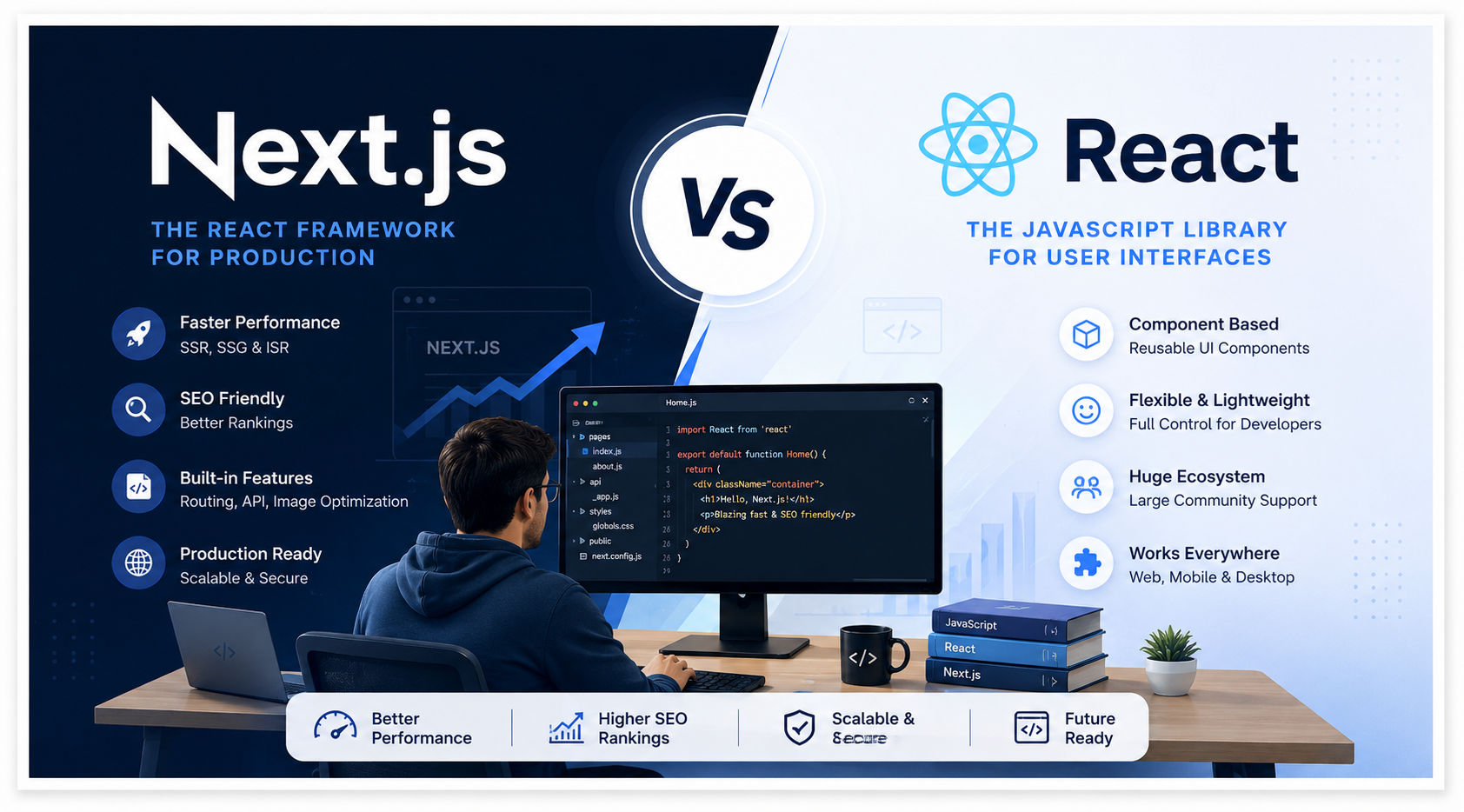
Next.js vs React: Which Framework Should You Choose for Your Business Website in 2026?
When planning a new website or web application, one of the first technical decisions you'll encounter is choosing the right frontend technology. If you've explored modern web development, you've likely come across React and Next.js. These two technologies are among the most popular choices for developers and businesses worldwide.
Many people think React and Next.js are direct competitors, but that's not entirely true. In fact, Next.js is built on top of React. Understanding how they differ is essential for making the right decision for your project.
Whether you're launching a startup, redesigning your company website, creating an eCommerce platform, or developing enterprise software, choosing the right technology can influence your website's speed, search engine visibility, user experience, and future scalability.
In this guide, we'll explain the differences between Next.js and React in simple terms and help you decide which option is best for your business in 2026.
What is React?
React is an open-source JavaScript library developed by Meta (Facebook) for building user interfaces.
It allows developers to create reusable UI components that make websites faster, more interactive, and easier to maintain.
React is widely used because it offers flexibility. Developers can build anything from a simple landing page to complex web applications using React.
Popular companies using React include:
- Netflix
- Airbnb
- WhatsApp Web
React focuses primarily on building the frontend (user interface). However, developers usually need additional tools for routing, SEO, server-side rendering, authentication, and backend integration.
What is Next.js?
Next.js is a React framework developed by Vercel.
It extends React by adding powerful built-in features that developers commonly need while building production-ready applications.
Instead of configuring multiple libraries separately, Next.js provides many features out of the box.
These include:
- Server-Side Rendering (SSR)
- Static Site Generation (SSG)
- File-Based Routing
- API Routes
- Image Optimization
- Automatic Code Splitting
- Built-in SEO Support
- Middleware
- Edge Functions
Because of these features, Next.js has become one of the most preferred technologies for modern business websites and enterprise applications.
Understanding the Difference
The easiest way to understand it is with a simple example.
Imagine React as a powerful engine.
Next.js is a complete high-performance car built using that engine.
React gives developers complete flexibility, while Next.js provides a ready-to-use structure with many advanced features already included.
That's why many businesses now prefer Next.js for commercial websites.
Performance Comparison
Website speed is one of Google's ranking factors.
A slow-loading website can negatively affect user experience, SEO rankings, and conversion rates.
React applications generally render content in the browser (Client-Side Rendering). This means users may wait slightly longer before seeing the complete page.
Next.js supports Server-Side Rendering and Static Site Generation, allowing pages to load much faster and improving Core Web Vitals.
Benefits of Next.js performance include:
- Faster initial page load
- Better Largest Contentful Paint (LCP)
- Improved Core Web Vitals
- Lower bounce rates
- Better user experience
- Faster indexing by search engines
For businesses that depend on online visibility, these performance improvements can directly impact traffic and conversions.
SEO Comparison
One of the biggest differences between React and Next.js is Search Engine Optimization.
React websites often require additional configuration to achieve strong SEO performance.
Next.js includes several SEO-friendly features by default, making it easier for search engines like Google to crawl and index your pages.
Advantages of Next.js for SEO include:
- Faster page rendering
- Optimized metadata
- Dynamic meta tags
- Automatic sitemap support
- Better indexing
- Structured data support
- Improved page speed
If your business relies on organic traffic from Google, Next.js usually provides a stronger foundation.
Developer Experience
React offers complete freedom.
Developers can choose their preferred routing library, state management solution, styling framework, and build tools.
While this flexibility is powerful, it also increases project setup time.
Next.js reduces much of this complexity by providing an opinionated structure with built-in routing, optimization, and deployment support.
This helps teams build applications faster while following consistent development practices.
Scalability
As businesses grow, websites become larger and more complex.
Modern web applications often require:
- Authentication
- Dashboards
- Payment Integration
- Analytics
- Customer Portals
- API Integration
- Multiple User Roles
- Admin Panels
Next.js makes scaling these applications easier because many enterprise-ready features are already built into the framework.
React can certainly handle large projects, but developers typically need to integrate several additional libraries to achieve similar functionality.
React vs Next.js Comparison Table
| Feature | React | Next.js |
|---|---|---|
| Type | JavaScript Library | React Framework |
| SEO Support | Requires additional setup | Built-in SEO optimization |
| Rendering | Client-Side Rendering (CSR) | SSR, SSG, ISR & CSR |
| Routing | Requires React Router | File-based Routing |
| Performance | Good | Excellent |
| Image Optimization | Manual | Built-in |
| API Support | External Backend Required | Built-in API Routes |
| Deployment | Flexible | Optimized for Vercel & Cloud |
| Learning Curve | Easy | Moderate |
| Best For | Single Page Applications | Business Websites & Enterprise Apps |
Advantages of React
React remains one of the most popular frontend libraries for a reason. It gives developers complete flexibility to build applications exactly the way they want.
Benefits of React
- Easy to learn for beginners
- Huge developer community
- Thousands of third-party libraries
- Highly reusable components
- Excellent for Single Page Applications (SPAs)
- Flexible architecture
- Strong ecosystem
- Backed by Meta (Facebook)
If your project doesn't require advanced SEO or server-side rendering, React is still an excellent choice.
Advantages of Next.js
Next.js has become the preferred framework for modern websites because it solves many common problems developers face while using React alone.
Benefits of Next.js
- Better SEO
- Faster page loading
- Built-in Routing
- Server Side Rendering
- Static Site Generation
- Automatic Image Optimization
- API Routes
- Excellent Core Web Vitals
- Better Google Ranking Potential
- Enterprise Ready
Businesses looking for long-term growth often choose Next.js because it combines performance with scalability.
Real Business Example
Imagine two companies launching their websites.
Company A uses React
The website looks beautiful and works well, but search engines take longer to index pages because most of the content is rendered in the browser.
The development team also spends additional time configuring routing, SEO metadata, image optimization, and deployment.
Company B uses Next.js
The website loads almost instantly.
Search engines can easily crawl every page.
Images are automatically optimized.
Metadata is generated efficiently.
The website achieves better Core Web Vitals scores and provides a smoother experience across mobile and desktop devices.
Over time, Company B gains more organic traffic simply because the technical foundation supports better SEO and performance.
Which One Should You Choose?
The right choice depends on your project requirements.
Choose React if:
- You're building an internal dashboard
- SEO is not a priority
- You need complete development flexibility
- You're creating a simple Single Page Application
- Your project already has an established backend
Choose Next.js if:
- You want better Google rankings
- Website speed is important
- You are building a company website
- You're creating an eCommerce platform
- You need excellent SEO
- Performance matters
- You plan to scale in the future
- You want a modern production-ready framework
For most businesses in 2026, Next.js is often the stronger choice because it offers a better balance of developer experience, performance, and search engine optimization.
Common Use Cases
React
- CRM Systems
- Admin Dashboards
- SaaS Applications
- Internal Portals
- Interactive Web Applications
Next.js
- Business Websites
- Corporate Portals
- Blogs
- News Websites
- eCommerce Stores
- Portfolio Websites
- Landing Pages
- Enterprise Applications
Future of Web Development
The web development landscape continues to evolve rapidly.
Businesses now expect websites that are:
- Fast
- Secure
- Mobile Responsive
- SEO Friendly
- AI Ready
- Scalable
- Easy to Maintain
Frameworks like Next.js are evolving alongside these expectations, making it easier to build applications that meet modern performance standards.
React will continue to be a core technology, while frameworks built on React are likely to play an even bigger role in production environments.
Article Comments
You must be signed in to post comments.
Sign In to Join the Discussion →No comments approved yet. Be the first to share your thoughts!
About the Author
Pratik Mali
Technology Consultant
Professional engineers crafting clean code architectures and visual portfolios for SMBs.