


The 3 Careers That Will Pay the Most in 2026–2030 — AI, Quantum, and the End of Engineering Silos

Praveen Kumar
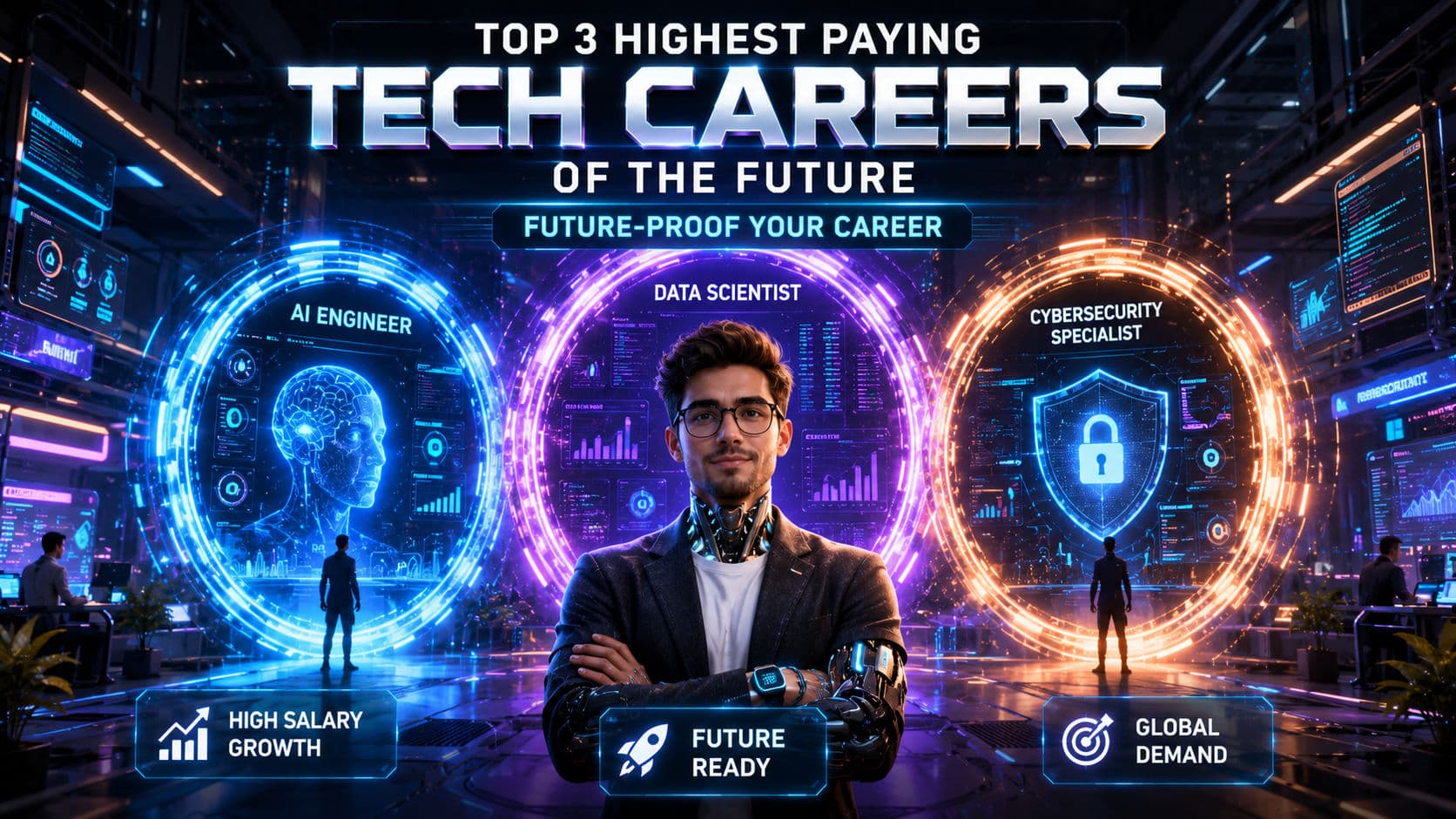
The Rules Changed. Most People Have Not Been Told Yet.
For the past twenty years, the career advice for Indian engineering students was straightforward: get a computer science degree, learn to code, join an IT services company or a product startup, and build from there. The path was clear. The outcomes were predictable.
That path still works. But the highest-paying and fastest-growing opportunities of the next decade are not on it. They are adjacent to it — in domains that did not exist at commercial scale five years ago, require skills that most engineering curricula have not yet caught up to, and are currently starved of qualified people in ways that create salary premiums that are genuinely unusual in the Indian job market.
Three domains define this shift. They are not predictions — they are already hiring. The question is whether you are positioned to participate.
Career 1 — AI Foundation Model Architects
The AI tools you use every day — Claude, GPT, Gemini, Grok — are built on foundation models. Large language models, multimodal models, reasoning models. These are not products you build by assembling libraries. They are research-engineering systems that require deep expertise in distributed training, transformer architecture, RLHF alignment, evaluation methodology, and the infrastructure required to train systems at scale across thousands of GPUs simultaneously.
The people who build these systems are not regular software engineers. They are a specific, rare category of engineer-researcher hybrid — comfortable reading and implementing academic papers, capable of working at the intersection of theoretical machine learning and production engineering, and able to navigate the gap between a model that works in a research notebook and one that serves billions of requests per day reliably.
Meta's research into large concept models — which process meaning at the concept level rather than the token level — represents one direction this field is heading. OpenAI's work on reasoning models, Anthropic's work on interpretability and alignment, and Google DeepMind's work on multi-modal architectures represent others. All of these require the same scarce skill set, and all of them are actively hiring.
The compensation reflects the scarcity. At top AI labs globally, foundation model engineers command packages that rival or exceed quant finance roles — total compensation above $500,000 per year at the senior level in the US market is not unusual. In India, the trajectory is different in scale but similar in direction. AI research and foundation model roles at Indian offices of Google, Microsoft, and Meta, as well as at Indian AI startups building proprietary models, are among the highest-compensating engineering roles in the country.
The realistic path for most Indian engineers is not building the next GPT from scratch. It is developing the skills — deep learning theory, large-scale distributed training, model evaluation, alignment techniques — that make you valuable in the teams that build and maintain these systems. That path starts with mathematical foundations (linear algebra, probability, calculus at a level beyond undergraduate coursework), moves through transformer architecture and training dynamics, and ultimately requires hands-on experience with the infrastructure at scale.
The top three percent of professionals in this domain will be among the highest-paid technology workers on Earth for the next decade. The window to build the foundational skills is now, before the field is crowded.
Career 2 — Quantum Computing Engineers
Quantum computing is the career domain where the gap between available talent and actual demand is most extreme — and therefore where the salary premiums are most dramatic for anyone who moves early.
The numbers tell the story directly. The global pure-play quantum workforce reached nearly 16,500 professionals in 2025, up 2,000 in a single year, with projections of 250,000 new quantum sector jobs by 2030. Roughly 50 to 66 percent of quantum job openings currently go unfilled. Global quantum-related job postings grew roughly 180 percent between 2020 and 2024, while the pool of qualified applicants has not kept pace.
In India specifically, the opportunity is larger than most people realize. NASSCOM estimates quantum computing jobs in India to rise to over 20,000 by 2030, compared to approximately 800 in 2023. India's National Quantum Mission has unlocked ₹6,000 crore — and ISRO and DRDO are planning to increase hiring for quantum research by four times under India's Quantum Defence Roadmap.
The companies hiring right now include names Indian engineers already know. IBM India, QNu Labs, and BosonQ Psi are active in the startup ecosystem involving IISc in Bengaluru. Microsoft Research India and the TCS quantum lab also have a presence in Bengaluru. Reliance Jio has a quantum-safe networking team, and Infosys Quantum Living Labs in Pune actively posts quantum cloud integration roles.
The salary reality is compelling. Entry-level quantum engineers at Indian startups earn ₹8 to 14 LPA. Mid-level roles at MNCs like IBM India range from ₹25 to 45 LPA. Senior-level roles above ₹40 LPA are available for professionals with advanced qualifications and global research experience. Globally, Quantum Error Correction engineers earn $150,000 to $210,000 at entry level, rising to $300,000 to $400,000 at senior levels.
Why quantum computing specifically, and why now? The disruption timeline is tightening. Quantum computers powerful enough to break current RSA and elliptic curve encryption — the mathematical foundations of virtually all internet security — are projected to become available within three to five years. When that happens, every piece of encrypted data on the internet, every password system, every secure communication protocol will need to be rebuilt from the ground up using post-quantum cryptography. The scale of that transition is comparable to rebuilding the entire internet's security infrastructure simultaneously. The engineers who understand both the quantum threat and the post-quantum solution will be indispensable.
The skills required are real and demanding. Linear algebra and quantum mechanics fundamentals are non-negotiable. Hands-on Qiskit or PennyLane experience outweighs a purely theoretical degree in most startup job postings. Familiarity with AWS Braket or Azure Quantum is a bonus skill that separates candidates at MNC interviews.
This is not a five-year-away opportunity. IBM Quantum and TCS jointly offer Quantum Software Engineer roles in Bengaluru focused on Qiskit development right now. The engineers who build skills today will be mid-level practitioners with two to three years of experience by the time the quantum transition peaks — precisely the career stage where compensation and opportunity are largest.
Career 3 — Cross-Disciplinary Engineers: AI Embedded in Everything
The third career domain is the broadest and in some ways the most important for the largest number of Indian engineers — not because it pays the most in absolute terms, but because it defines what becomes a baseline requirement versus what commands a premium.
Engineering disciplines that were siloed for decades are converging. This has been happening gradually for twenty years — electrical engineering absorbed computer science, biomedical engineering absorbed data science, mechanical engineering absorbed simulation and computational modeling. What AI is doing now is accelerating and radicalizing that convergence.
Consider what AI has already entered: refrigerators with voice interfaces, air conditioners with predictive usage models, manufacturing lines with computer vision quality control, agricultural equipment with yield prediction systems, healthcare diagnostics with imaging analysis. The traditional boundaries between "tech industry" and "non-tech industry" are dissolving. Every industry is becoming a technology industry that happens to also do something else.
The practical implication for engineering careers is significant. A mechanical engineer who understands how to deploy a computer vision model for quality control in a manufacturing plant is not competing in the same talent pool as either a pure mechanical engineer or a pure ML engineer. They are a rarer combination that both industries need and neither produces in sufficient numbers.
The same pattern repeats across domains. A biomedical engineer who can build and evaluate diagnostic AI systems. A civil engineer who can design and operate smart infrastructure with sensor networks and predictive maintenance models. A chemical engineer who can use AI-accelerated molecular simulation for drug discovery or materials design.
These are not hypothetical roles. They are live job postings at Indian companies and MNCs right now, and they are consistently harder to fill than either pure-technical or pure-domain roles because the talent pipeline that produces them — engineers who went deep in a traditional discipline and then developed genuine AI competency, not just surface familiarity — is thin.
The business reality reinforces this. Almost every new company being built today requires a digital presence, software infrastructure, and increasingly AI-powered systems from day one — often with a founding team of three to four engineers who cannot afford to specialize narrowly. The engineer who can build the product, the backend, the AI integration, and the analytics layer is extraordinarily valuable at early-stage companies where headcount is limited.
The Common Thread Across All Three
These three career domains look different on the surface. Foundation model engineering is deeply theoretical and research-adjacent. Quantum computing is physics-intensive and hardware-adjacent. Cross-disciplinary AI integration is broad and applied. But they share a structural characteristic that explains why all three will outperform traditional software engineering careers over the next decade.
All three are at the intersection of deep domain expertise and AI capability. Pure AI knowledge without domain depth produces people who can run models but not deploy them effectively. Pure domain depth without AI capability produces people who will be replaced by those who have both. The combination — someone who genuinely understands both the domain and the AI systems that operate within it — is what the market is paying a premium for and will continue to pay a premium for as the technology matures.
The Indian engineering ecosystem is unusually well positioned to capitalize on this. India produces more engineers per year than almost any country on Earth, has strong mathematical education foundations at the IIT and NIT level, and has a large existing talent pool in software that can develop adjacent skills in AI and quantum. The National Quantum Mission's ₹6,000 crore investment creates institutional infrastructure. The global AI labs have Indian research centers. The supply chain for these careers exists in a way it did not five years ago.
The question is not whether these careers will be valuable. They already are. The question is whether individual engineers will recognize the opportunity early enough to build the skills while the talent pool is still thin and the salary premiums are still large.
The Practical Starting Point
For Indian engineers reading this and wondering where to begin:
If foundation model engineering interests you, start with the mathematical foundations — Andrew Ng's deep learning specialization on Coursera, followed by Andrej Karpathy's Neural Networks Zero to Hero series, followed by reading and implementing original transformer papers. The path is long but the direction is clear.
If quantum computing interests you, start with IBM's free Qiskit learning resources and MIT OpenCourseWare 8.04 for quantum physics fundamentals. The Qiskit IBM certification is the single most recognized credential across Indian quantum job postings right now. C-DAC's quantum computing certification is increasingly listed as preferred in TCS and Infosys job descriptions.
If cross-disciplinary integration interests you, the starting point is identifying which domain you already have depth in — mechanical, biomedical, civil, chemical — and then systematically building AI competency on top of it. The goal is not to become a pure ML engineer. It is to become the person in your domain who can evaluate, deploy, and operate AI systems that domain experts cannot build themselves.
The window is open. It will not stay open forever.
Published by APXTECK — AI Integration and Technology Strategy for Indian Developers and SMBs. We help Indian businesses and developers build with the technologies that will matter most in the next decade. Talk to us →
Article Comments
You must be signed in to post comments.
Sign In to Join the Discussion →No comments approved yet. Be the first to share your thoughts!
About the Author

Praveen Kumar
Co-Founder & DirectorFull-Stack Developer, APXTECK
Praveen Kumar is the Co-Founder and Full-Stack Developer at APXTECK, an AI-powered IT agency helping Indian SMBs grow through web development, automation, and AI integration. He builds production-grade systems using Node.js, Next.js, PostgreSQL, and modern AI APIs. When he is not shipping code, he is writing about practical technology that actually works for Indian businesses.
Related Insights

GPT-5.6 vs Grok 4.5 vs Claude Fable 5 — I Built the Same GTA Game With All Three. Here Is the Honest Result.

OmniRoute: The Free Open-Source Tool That Connects Claude Code, Cursor, and Codex to 1.6 Billion Free Tokens Every Month

How to Grow Your Business: The 4 Powerful Growth Strategies Explained

Microsoft's Record 570 Security Fixes: What Every Business and IT Team Should Learn About Modern Cybersecurity

Sonam Wangchuk Hunger Strike LIVE: CJP Announces Mass Hunger Strike on July 16, Peaceful Parliament March Planned for July 20

What Developers Can Learn from Recent Grok AI Repository Upload Reports

Mandatory Certificates and Registrations Every Indian Startup Needs in 2026