


GPT-6 Astra: OpenAI’s New AI Model Could Change Software Development and Business Work

APX Teck
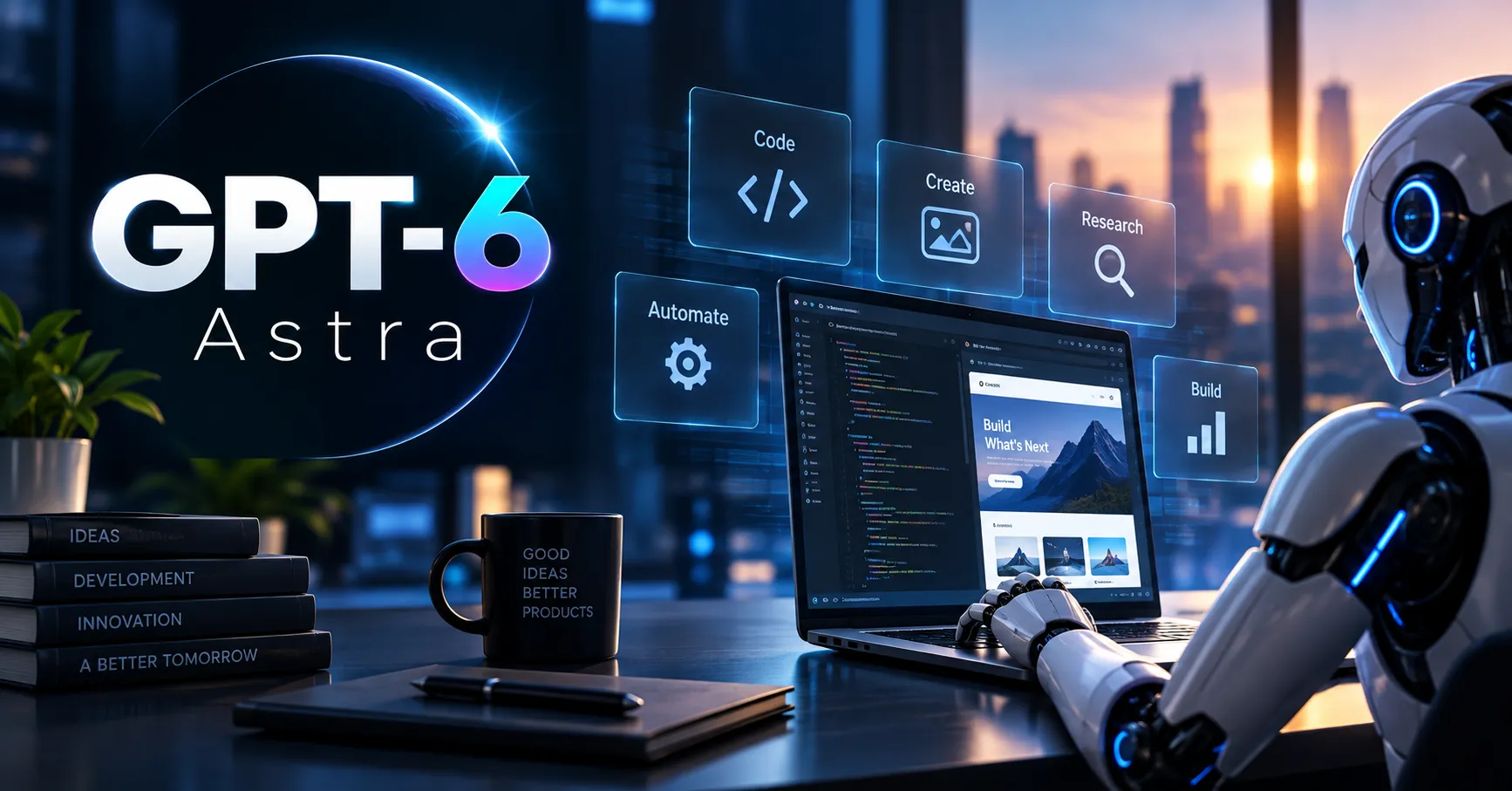
GPT-6 Astra: OpenAI’s New AI Model Could Change Software Development and Business Work
Artificial intelligence is moving into a new phase.
For years, AI assistants were primarily used to answer questions, generate text, write code and summarize information. Today, the direction is changing. The most capable AI systems are increasingly being designed to use computers, navigate software, perform multi-step tasks and work alongside people on complex professional workflows.
That shift is at the center of OpenAI’s latest model, GPT-6 Astra.
OpenAI describes GPT-6 Astra as a new generation of intelligence designed for complex work across computer use, browsing, software engineering, cybersecurity, science and professional tasks. The model is also designed to better understand user intent and maintain the broader objective of a task as requirements change.
But the bigger question for businesses and developers is not simply, “How powerful is the new model?”
The more important question is:
What happens when AI can increasingly perform the work instead of only explaining how to do it?
From AI Answers to AI Action
The biggest change happening in AI is the movement from conversation toward execution.
A traditional AI assistant might explain how to complete a task. A more capable computer-use system can potentially interact with the software environment itself.
OpenAI says GPT-6 Astra can handle tasks such as filling online forms, updating CRM records, organizing calendars, conducting research, creating websites, running frontend quality checks and troubleshooting software.
That changes the role of AI.
Instead of:
Ask → Receive answer → Manually execute
the workflow can increasingly become:
Instruct → AI works → Review → Improve
Human oversight remains important, but the amount of repetitive work that AI can potentially handle is expanding.
Why GPT-6 Astra Matters for Developers
Software development is one of the areas where this change could be particularly significant.
Developers already use AI for code generation, debugging, documentation and testing. GPT-6 Astra extends that direction toward more complex engineering workflows.
OpenAI reports a 57.9% result on Terminal-Bench 4.0, compared with 37.3% for GPT-5.6 Sol in the comparison published with the announcement. On DeepSWE v1.1, Astra scores 74.1%.
These benchmark numbers should not be interpreted as meaning that AI has replaced software engineers.
Real-world software development involves much more than writing code.
It requires:
- Understanding business requirements
- Designing architecture
- Making technology decisions
- Managing security
- Reviewing code
- Testing edge cases
- Maintaining systems
- Understanding users
The opportunity is therefore not necessarily AI replacing developers.
It is developers using AI to increase the amount of valuable work they can accomplish.
The Next Step in AI-Assisted Development
Consider the difference between two requests.
Request 1:
“Write a React login component.”
Request 2:
“Build the login experience, connect it to the application, test the main user flows, identify problems and improve the implementation.”
The second request is a workflow rather than a single coding task.
That distinction matters.
Modern AI systems are increasingly being developed to reason through multiple steps, use tools and continue working toward a broader objective.
For development teams, this could mean AI taking a larger role in:
Planning
Breaking requirements into practical technical tasks.
Development
Creating or modifying application code.
Testing
Running tests and identifying failures.
Debugging
Investigating problems and suggesting or implementing fixes.
Documentation
Preparing technical documentation based on the project.
Quality Assurance
Checking whether applications behave as expected.
The developer remains responsible for important technical and business decisions, while AI can take on more execution-heavy work.
A Major Opportunity for Web Development
Web development could also experience a significant shift.
A typical digital product involves many stages:
Research → Design → Development → Testing → Content → SEO → Deployment
AI can potentially assist at several points in that chain.
OpenAI says GPT-6 Astra can create websites and web applications and perform frontend quality checks. Through Sites in ChatGPT, Astra can also create, host and share websites, web apps and games directly from a prompt.
For startups and small businesses, this could reduce the time required to move from an idea to an initial working product.
For established companies, it could help development teams prototype ideas faster and spend more time on architecture, product strategy and user experience.
AI Could Change UI/UX Testing Too
Building a visually attractive website is only one part of good digital design.
A successful interface should also be:
- Easy to navigate
- Responsive across devices
- Accessible
- Consistent
- Fast
- Clear
- Focused on the user's goals
Computer-use capabilities create an interesting possibility here.
Instead of simply reviewing screenshots, AI can increasingly interact with websites and applications.
That could help teams identify issues such as broken interactions, confusing navigation or problems in important user journeys.
Human designers will still make the final decisions, but AI can become an additional layer of testing and feedback.
Professional Work Is Becoming More AI-Assisted
The impact of GPT-6 Astra extends beyond programming.
OpenAI says the model is designed to work with documents, spreadsheets, presentations and analyses while following templates, instructions and business requirements.
This is important because real business work rarely happens inside a single application.
A marketing team may research information, prepare a spreadsheet, create a presentation and write a report.
A finance team may analyze data and prepare business documents.
An operations team may update systems, review information and coordinate multiple tasks.
As AI becomes better at handling these connected workflows, businesses may start thinking of AI less as a chatbot and more as a digital work assistant.
What About AI Security?
Greater capability also brings greater responsibility.
The more access an AI system receives, the more important permissions, monitoring and safeguards become.
OpenAI's GPT-6 Astra safety overview says the model is its first to reach the Critical level of cybersecurity capability under its Preparedness Framework. OpenAI also describes strengthened safeguards, monitoring and protections against harmful cyber actions and prompt-injection-related risks.
For businesses, this is an important lesson.
AI agents should not automatically receive unrestricted access to company systems.
Organizations should carefully consider:
- Which applications an AI can access
- What information it can read
- Which actions require approval
- How activity is monitored
- How sensitive information is protected
- What happens when an AI makes a mistake
The future of AI adoption will therefore depend not only on capability, but also on responsible implementation.
What Developers Should Learn Now
Developers do not need to wait for the future to prepare for this shift.
There are several practical areas worth focusing on.
1. Learn AI-Assisted Development
Understand how AI can support coding, debugging, testing, documentation and research.
2. Strengthen Core Engineering Skills
Strong knowledge of architecture, databases, APIs, security and system design remains essential.
3. Learn to Review AI Output
AI-generated code should be tested and reviewed before being used in production.
4. Understand AI Security
Developers should learn about data exposure, prompt injection, permissions and secure AI integration.
5. Think in Workflows
Instead of asking:
“What can AI generate?”
start asking:
“Which part of my workflow can AI safely automate?”
That question can lead to much more practical business value.
What GPT-6 Astra Could Mean for Businesses
For startups, SMEs and enterprises, increasingly capable AI systems could change how digital products are developed and maintained.
A small team could potentially use AI to accelerate:
- Product development
- Market research
- Software testing
- Documentation
- Customer support
- Data analysis
- Website development
- Internal reporting
But speed should never become the only objective.
Businesses dealing with customer information, financial data, healthcare information or proprietary technology need appropriate controls before giving AI access to sensitive systems.
The goal should not be maximum automation.
The goal should be useful, controlled and measurable automation.
The Future Is Not Simply AI vs Developers
The discussion around AI often becomes focused on whether machines will replace people.
A more practical question is how people and AI will work together.
Developers will continue to make architectural decisions.
Designers will continue to understand users.
Business leaders will continue to define priorities.
AI can increasingly help with execution, analysis, testing and repetitive work.
That combination could become one of the most important advantages for technology companies in the coming years.
The real competitive advantage may not come from using the most AI. It may come from knowing where AI creates genuine value.
Key Takeaways
✔ GPT-6 Astra moves AI further toward computer-based and multi-step workflows.
✔ OpenAI reports improvements across coding, computer use, science, cybersecurity and professional work.
✔ Developers can potentially use AI for larger portions of development and testing workflows.
✔ Businesses may increasingly use AI for connected tasks instead of simple question-and-answer interactions.
✔ Strong security, permissions and human oversight remain essential as AI becomes more capable.
✔ Developers who understand both software engineering and AI workflows will be well positioned for the next stage of digital development.
Final Thoughts
GPT-6 Astra is significant not simply because it is another new AI model.
Its importance lies in the direction of the technology.
AI is moving from generating information toward helping execute work.
That could influence how software is developed, how websites are tested, how businesses process information and how teams approach everyday digital tasks.
The companies that benefit most may not necessarily be the ones that automate everything.
They will be the ones that understand what should be automated, what should remain under human control and how technology can create measurable value.
For developers and businesses, the question is no longer only:
“What can AI do?”
The better question is:
“What valuable work can we safely do better with AI?”
That is where the next opportunity begins.
How APXTECK Can Help Businesses Build for the AI Era
As AI becomes part of modern business workflows, companies need digital platforms that can support automation, integrations, scalability and strong user experiences.
APXTECK works on modern digital solutions including:
- Custom Web Applications
- AI-Powered Software
- Enterprise Solutions
- UI/UX Design
- Full-Stack Development
- Cloud-Based Applications
- API Integrations
- Digital Transformation
If your business is exploring an AI-powered product or wants to modernize an existing digital platform, the right technology architecture can turn an idea into a scalable solution.
Explore more technology insights:
https://www.apxteck.com/insights-news
Learn more about APXTECK:
https://www.apxteck.com/
Talk to the APXTECK team:
https://www.apxteck.com/contact
Article Comments
You must be signed in to post comments.
Sign In to Join the Discussion →No comments approved yet. Be the first to share your thoughts!
About the Author

APX Teck
AI & Technology Consultant
Exploring artificial intelligence, software development, emerging technologies and digital transformation to help businesses understand and adopt technology with practical insight.
Related Insights

UPI MDR Is Back — Ashneer Grover Is Half Right | APXTECK

Amodei Wants to Slow AI. Indian SMBs, Read This First | APXTECK

How Blinkit's Free Ambulance Became Its Best Marketing Move

AI-Powered Cyberattacks Are Rising: Why Every Business Needs Stronger Cybersecurity Now

How Next.js and Generative Search Help Builders Win Leads

Build Your Own Food Delivery App: Stop Giving Your Profits to Swiggy & Zomato

How to Hire the Right Business Automation Without Burning Your Seed Capital