


Zomato's Notifications Work. Copying Them Will Hurt You.

Praveen Kumar
Zomato's Notifications Work. Copying Them Will Hurt You.
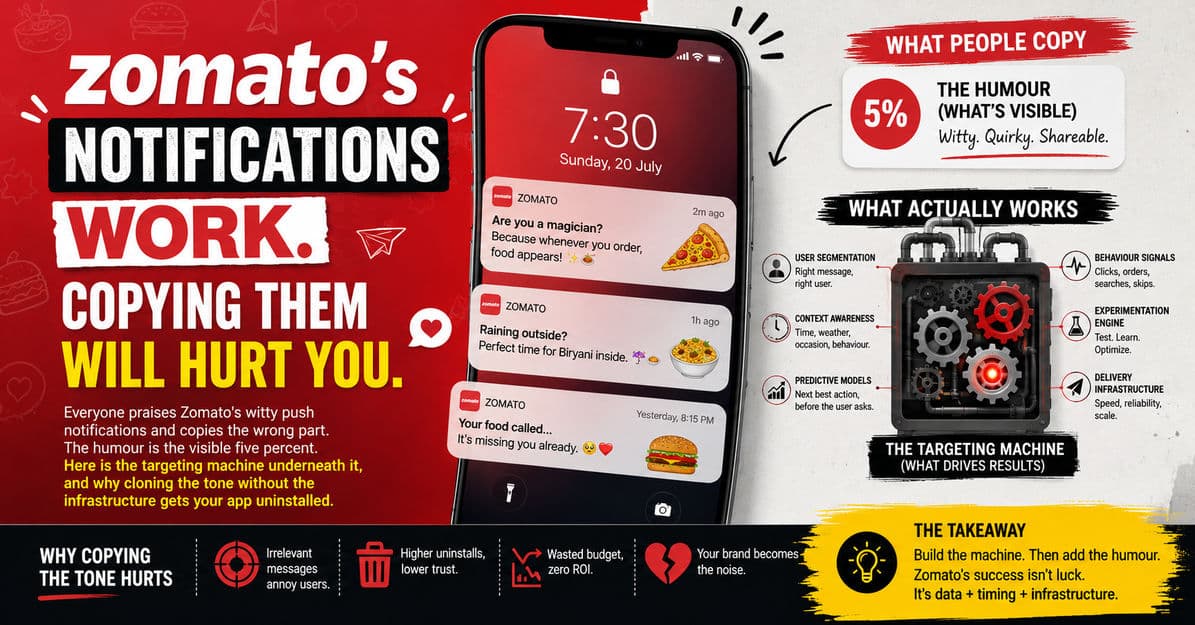
Every few months a screenshot of a Zomato notification goes viral, a hundred LinkedIn posts declare it a masterclass in brand voice, and somewhere a founder tells their marketing intern to "make our notifications fun like Zomato's." Three weeks later the app's opt-out rate has doubled and nobody connects the two events.
The problem is that the joke is the only part of Zomato's push notification strategy that is publicly visible. It is also the least important part. What actually makes those messages work is a targeting and measurement apparatus that most Indian SMBs do not have, cannot afford, and — this is the part nobody says out loud — do not need. Copy the visible five percent without the invisible ninety-five and you have built a machine for annoying your own customers in a distinctive voice.
What Zomato Is Actually Doing Underneath the Wordplay
Strip the puns out and the operating logic is unglamorous.
Every message has exactly one job
Each notification is built to cause one specific thing: an order from an active user, a reactivation of a lapsed one, or the redemption of a specific offer. Messages without a defined outcome do not get sent. This sounds obvious and it is the single most commonly violated rule in Indian SMB marketing, where the default notification is a general-purpose announcement that something exists — a new product line, a festival sale, an updated app version — aimed at everybody and asking for nothing in particular.
A user whose ordering frequency is slipping gets a message built from their own order history, referencing a cuisine they actually buy. That is not comedy writing. That is a segmentation query with copy wrapped around it.
Timing is a variable, not an afterthought
Send windows in India cluster reliably: the morning commute, the lunch break, and the 8–10 PM evening window. Zomato treats time of day, order recency and cart history as inputs to the send decision, and the copy is generated to fit the resulting segment. The late-night snack message exists because the segment exists, not because someone thought of a funny line about midnight hunger and then went looking for people to send it to.
The humour is a delivery mechanism for relevance
The wit does real work — it buys tolerance. A message that makes you smile costs you less attention than one that does not, so the same user will accept a higher frequency before reaching for the settings screen. But wit only extends tolerance; it does not create relevance. An irrelevant funny notification is still an irrelevant notification, and users figure that out faster than marketers expect.
The Scale That Makes This Affordable
Here is the context that gets left out of every "Zomato notification masterclass" post.
In Q4 FY26, Zomato's food delivery business reported 25.4 million average monthly transacting customers, up from 20.9 million a year earlier. Parent company Eternal reported FY26 revenue of ₹54,364 crore. Blinkit alone processed 273.9 million orders in the quarter across 27.2 million monthly transacting users at a net average order value of roughly ₹525.
| What scale buys | Zomato's position | Typical Indian SMB position |
|---|---|---|
| A/B test sample size | Millions of users per variant, results in hours | A few thousand users total, weeks for significance |
| Cost of a bad send | Fractional opt-out on a huge base, absorbed | A meaningful share of your entire list, unrecoverable |
| Dedicated copy team | Full-time writers with brand guardrails and legal review | Founder writing copy at 11 PM between other jobs |
| Segmentation depth | Order history, cuisine, time-of-day, price sensitivity, city | Perhaps purchase date and city |
| Recovery from a misfire | PR team, national coverage cycle, moves on | Customers uninstall and do not come back |
That last row is the one that matters. Zomato can afford to be wrong occasionally because it is right at enormous volume. A furniture retailer in Coimbatore with 4,000 app installs cannot.
Global push benchmarks in 2026 sit at roughly 20–25% open rates and 4–6% click-through. Those are the averages Zomato optimises above. If you have 4,000 installs, a 5% CTR is 200 clicks — a number where one week of bad copy is statistically indistinguishable from one week of good copy. You cannot iterate your way to Zomato's quality because you do not have the data density to know which iterations worked.
Why Copying the Voice Backfires
The failure mode is not theoretical and Indian quick-commerce has already demonstrated it.
Zepto sent a customer a notification reading that an emergency contraceptive pill missed her, complete with crying emojis. The recipient posted the screenshot on LinkedIn, it drew thousands of reactions, and Zepto publicly acknowledged the message was thoughtless and potentially harmful before retraining the team and changing its process. That message was written in exactly the playful, personified register everyone admires in Zomato's copy. Applied to the wrong product category, the same register became a serious brand incident.
Zomato itself has been on the wrong side of this. In 2022 it pulled an advertisement after a reference to "Mahakal" — intended as a restaurant partner's name — drew objections in Ujjain, and issued a public apology. Playful, culturally-referencing copy has a much wider blast radius in India than in most markets, because the same message lands across dozens of linguistic and religious contexts simultaneously.
Frequency is where most SMBs actually lose
Industry data is blunt about this: sending one push notification per week is associated with roughly 10% of users disabling notifications and about 6% uninstalling the app. Too many notifications is the most commonly cited reason users classify push messages as spam.
And the permission environment has tightened. Android used to opt users in by default, with opt-in rates in the 80–90% range. Since Android 13's runtime notification permission, average opt-in has fallen to around 60%. One Indian private bank working with Netcore saw a 35% drop in customer engagement and a 65% drop in push reach as Android 13 rolled through its user base.
So the channel is now permissioned on both platforms, your reach is roughly two-thirds of what it used to be, and every send carries a measurable uninstall cost. This is not the environment in which to experiment with being funny.
The Part Nobody Budgets For: Your Voice Becomes Forgeable
In June 2026, a screenshot circulated showing what appeared to be a Zomato push notification making a crude joke about the viral "₹370 biryani" consent controversy. It was fake. Zomato had to publish a formal clarification stating it had not written, designed or sent the message.
The instructive detail is why the forgery was believable. Zomato's voice is so recognisable and so consistently irreverent that a fabricated message in that voice passed as plausible to a large number of real users. A distinctive brand voice is an asset that accrues value and, past a certain point, becomes an attack surface. If your copy is recognisable enough to be loved, it is recognisable enough to be impersonated — and you will need a monitoring and response process for that, which is a cost nobody includes in the "let's be witty like Zomato" plan.
What Indian SMBs Should Build Instead
The good news: the version that actually works for a business with 5,000 to 50,000 users is cheaper and duller than the one everyone is chasing.
| Priority | Do this | Not this |
|---|---|---|
| First | Transactional messages done well — order confirmed, dispatched, out for delivery, payment received | Promotional blasts to the full list |
| Second | Behaviour triggers — abandoned cart at 2 hours, reorder prompt at the user's own cycle length | Weekly newsletter-style pushes |
| Third | Two or three segments based on real purchase behaviour | One message to everyone |
| Fourth | Frequency cap, enforced in code, per user per week | Whatever the campaign calendar says |
| Last | Personality in the copy, within those constraints | Personality as the strategy |
Transactional beats promotional, permanently
Order and delivery updates are the notifications users genuinely want, and they are the ones that keep the permission alive. Every business I audit has room to improve here before it has any business writing jokes. Precise, timely, informative status messages build the tolerance that later promotional messages spend.
Treat opt-out as a primary metric
Most SMB dashboards track opens and clicks. Almost none track the notification opt-out rate, which is the early warning signal — users typically disable notifications days or weeks before they uninstall. Instrument it, review it weekly, and treat a rising opt-out rate as a production incident rather than a marketing footnote.
Consider whether push is even your channel
For a lot of Indian SMBs it is not. WhatsApp Business API reaches customers who never installed your app, has vastly higher read rates than push, and carries a per-conversation cost that forces the discipline push notifications do not — when every message costs money, you stop sending pointless ones. The constraint is the feature.
Start Here This Week
Open your notification logs for the last 30 days. For each message sent, write down the single action it was designed to cause and whether you can measure it. Any message that fails that test should not have been sent, and the count of those failures is your real problem — not your tone of voice.
Then check whether you are tracking notification opt-outs at all. If you are not, add it before your next campaign. And if your transactional messages are vague, delayed, or missing, fix those first. A customer who reliably knows where their order is will forgive a lot. A customer receiving clever jokes while wondering whether their payment went through will not.
At APXTECK we build the retention infrastructure underneath this — event tracking, behaviour-triggered messaging, WhatsApp Business API integration, and dashboards that show opt-out trends before they become uninstalls. If your notification strategy is currently a copy document with no data behind it, let's talk.
Published by APXTECK — product and growth engineering for Indian businesses, without the fluff. apxteck.com/services
Article Comments
You must be signed in to post comments.
Sign In to Join the Discussion →No comments approved yet. Be the first to share your thoughts!
About the Author

Praveen Kumar
Co-Founder & DirectorFull-Stack Developer, APXTECK, chatgpt, google
Praveen Kumar is the Co-Founder and Full-Stack Developer at APXTECK, an AI-powered IT agency helping Indian SMBs grow through web development, automation, and AI integration. He builds production-grade systems using Node.js, Next.js, PostgreSQL, and modern AI APIs. When he is not shipping code, he is writing about practical technology that actually works for Indian businesses.
Related Insights

UPI MDR Is Back — Ashneer Grover Is Half Right | APXTECK

Amodei Wants to Slow AI. Indian SMBs, Read This First | APXTECK

How Blinkit's Free Ambulance Became Its Best Marketing Move

GPT-6 Astra: OpenAI’s New AI Model Could Change Software Development and Business Work

AI-Powered Cyberattacks Are Rising: Why Every Business Needs Stronger Cybersecurity Now

How Next.js and Generative Search Help Builders Win Leads

Build Your Own Food Delivery App: Stop Giving Your Profits to Swiggy & Zomato