


Next.js vs React: Which Framework Is Better for High-Performance Websites in 2026?

Amol Khodre
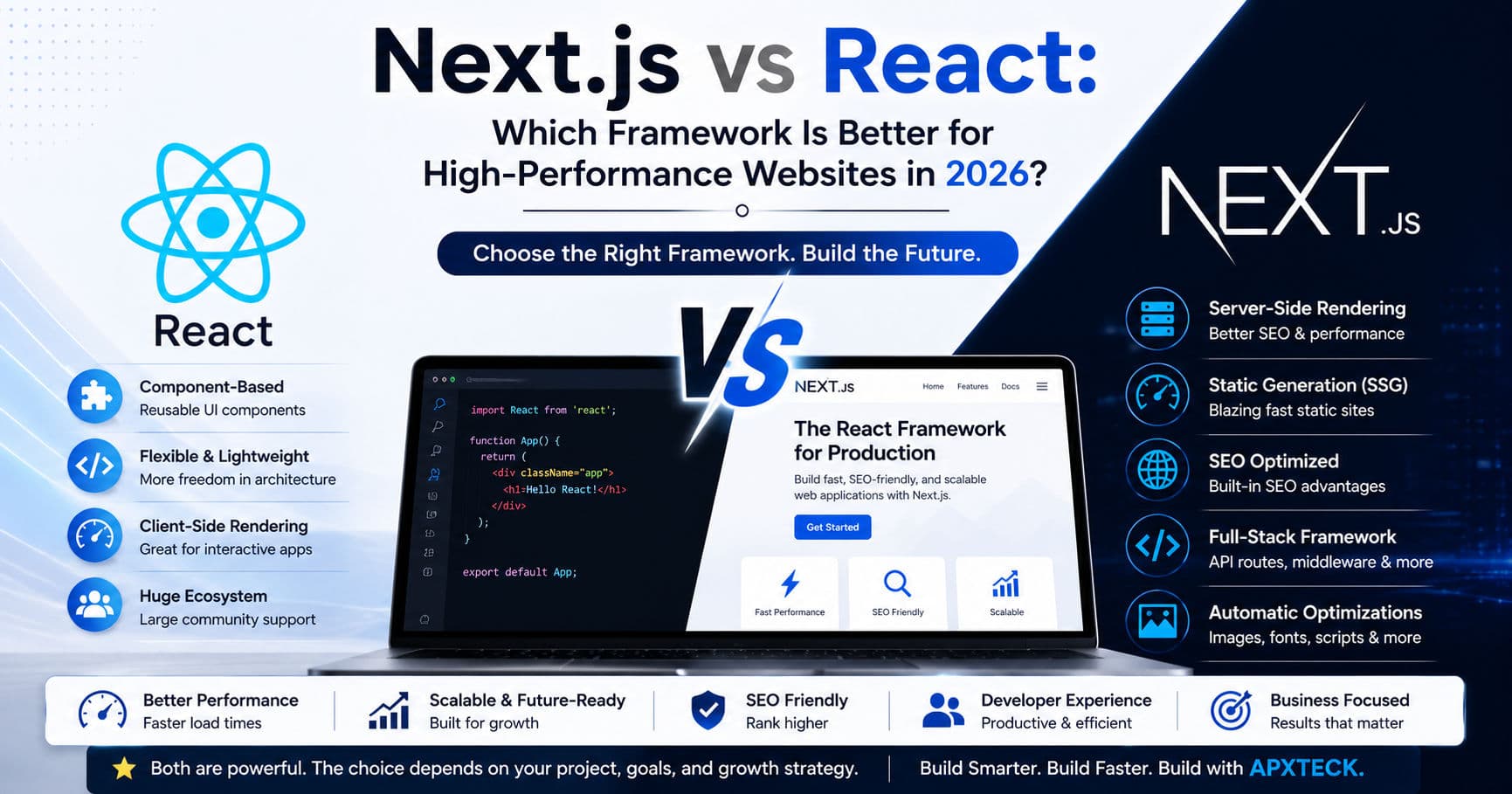
Next.js vs React: Which Framework Is Better for High-Performance Websites in 2026?
Choosing a modern JavaScript framework has become one of the most important decisions in web development. The technology stack you choose doesn't just influence how your application is built—it directly affects performance, SEO, scalability, user experience, development speed, and even long-term maintenance costs.
Among all available frontend technologies, React and Next.js are two of the most popular choices.
Although people often compare them as competitors, the reality is a little different.
React is a JavaScript library for building user interfaces, while Next.js is a full-stack React framework that extends React with advanced features such as Server-Side Rendering (SSR), Static Site Generation (SSG), API routes, image optimization, and improved SEO capabilities.
So the real question isn't:
"Which one is better?"
Instead, it's:
"Which one is better for your specific business requirements?"
In this guide, we'll explore the strengths, limitations, and ideal use cases of both technologies to help you make an informed decision.
Understanding React
React was introduced by Meta (formerly Facebook) and quickly became one of the world's most widely used JavaScript libraries.
Its primary purpose is simple:
Build fast, reusable, and interactive user interfaces.
React introduced the concept of component-based development, allowing developers to create reusable UI elements that make applications easier to maintain and scale.
Some of React's biggest advantages include:
- Reusable Components
- Virtual DOM
- Large Developer Community
- Flexible Architecture
- Rich Ecosystem
- Excellent Performance
- Massive Open Source Support
Today, companies like Facebook, Instagram, Airbnb, Netflix, and many other global organizations rely on React to power their applications.
What Is Next.js?
Next.js is an open-source React framework developed by Vercel.
Instead of replacing React, Next.js enhances it by solving many challenges developers commonly face when building production-ready applications.
It provides built-in features such as:
- Server-Side Rendering (SSR)
- Static Site Generation (SSG)
- Incremental Static Regeneration (ISR)
- Image Optimization
- Automatic Routing
- API Routes
- Metadata Management
- Middleware Support
- Better SEO
- Faster Initial Page Load
These capabilities make Next.js particularly attractive for business websites, enterprise portals, SaaS products, e-commerce platforms, and content-driven applications.
"React helps you build interfaces. Next.js helps you build complete production-ready web applications."
React vs Next.js: Understanding the Difference
One of the biggest misconceptions is that developers must choose either React or Next.js.
In reality:
Next.js is built on top of React.
Every Next.js application uses React internally.
Think of it this way:
React provides the building blocks.
Next.js provides the complete architecture.
It's similar to comparing an engine with a complete car.
The engine is essential, but the car includes everything needed for a complete driving experience.
Performance Comparison
Website speed directly influences:
- User Experience
- SEO Rankings
- Conversion Rates
- Bounce Rate
- Customer Satisfaction
React applications generally rely on client-side rendering, meaning much of the content is generated inside the user's browser after JavaScript loads.
Next.js offers multiple rendering strategies that allow pages to load faster and become visible to both users and search engines almost instantly.
As a result, Next.js often delivers:
- Faster First Contentful Paint (FCP)
- Better Largest Contentful Paint (LCP)
- Improved Core Web Vitals
- Better Mobile Performance
- Lower Bounce Rates
For businesses competing in search results, these performance improvements can make a measurable difference.
SEO: A Major Difference
Search engine optimization is one area where Next.js has a significant advantage.
Traditional React applications require additional configuration to ensure search engines can properly crawl and index content.
Next.js simplifies this process by supporting:
- Server-side rendering
- Static generation
- Automatic metadata handling
- Structured routing
- Optimized image delivery
- Better indexing
This makes Next.js an excellent choice for:
- Company Websites
- Blogs
- News Portals
- E-commerce Stores
- Marketing Websites
- SaaS Landing Pages
If your business depends on organic search traffic, SEO should never be an afterthought.
Continue Reading on APXTECK
Explore more expert guides:
👉 Why Your Business Needs a Custom Web Application to Scale in 2026
👉 Complete UI/UX Guide
👉 Technical SEO in 2026
👉 Explore More Technology Insights
https://www.apxteck.com/insights-news
Coming in Part 2
In the next section we'll cover:
- Rendering Methods (CSR, SSR, SSG, ISR)
- Scalability Comparison
- Developer Experience
- Business Use Cases
- React vs Next.js Comparison Table
- Pros & Cons
- Real-World Examples
- Internal Links
- Official External Resources
- FAQs
- Key Takeaways
- Final Conclusion
-
Professional CTA
One of the biggest reasons developers choose Next.js is its flexible rendering capabilities. Unlike traditional React applications, Next.js gives developers multiple rendering options depending on the project's needs.
Client-Side Rendering (CSR)
React applications primarily use Client-Side Rendering. Here, the browser downloads JavaScript first and then builds the page.
Best for:
- Dashboards
- Admin Panels
- Internal Tools
- CRM Systems
Server-Side Rendering (SSR)
Next.js can generate pages on the server before sending them to users.
Benefits include:
- Faster first-page load
- Better SEO
- Improved user experience
- Dynamic content
Ideal for:
- Business Websites
- News Portals
- Service Websites
- Corporate Platforms
Static Site Generation (SSG)
Pages are generated during the build process.
Advantages:
- Extremely Fast
- Highly Secure
- Better Performance
- Excellent SEO
Best suited for:
- Company Websites
- Blogs
- Documentation
- Landing Pages
Incremental Static Regeneration (ISR)
One of Next.js's standout features.
ISR allows pages to update automatically without rebuilding the entire website.
Perfect for:
- Product Catalogs
- News Websites
- Large Business Portals
- E-commerce Platforms
"The right rendering strategy isn't just a technical choice—it directly impacts performance, SEO, and user experience."
Scalability: Which Framework Grows Better?
Every growing business eventually asks the same question:
"Will our website still perform well when traffic increases?"
React provides an excellent foundation for building scalable interfaces, but developers often need additional tools and configurations to support enterprise-level applications.
Next.js simplifies this by offering:
- Built-in routing
- Optimized asset loading
- Code splitting
- Image optimization
- API integration
- Middleware support
- Server rendering
- Edge Functions
For businesses expecting rapid growth, these built-in capabilities reduce development complexity and improve long-term maintainability.
Developer Experience
A productive development environment helps teams build applications faster while reducing errors.
React Offers
- Complete flexibility
- Huge ecosystem
- Thousands of third-party libraries
- Strong community support
Next.js Adds
- Automatic Routing
- API Routes
- Built-in SEO
- Image Optimization
- Font Optimization
- Middleware
- File-based Structure
- Faster Deployment
For modern web development teams, these features save significant development time.
React vs Next.js Comparison
| Feature | React | Next.js |
|---|---|---|
| Learning Curve | Easy | Moderate |
| SEO | Requires additional setup | Excellent by default |
| Routing | External library | Built-in |
| Image Optimization | Manual | Built-in |
| Performance | Very Good | Excellent |
| Server Rendering | No | Yes |
| Static Generation | No | Yes |
| API Routes | No | Yes |
| Scalability | High | Enterprise Ready |
| Business Websites | Good | Excellent |
Which Businesses Should Choose React?
React is an excellent option if you're building:
- Internal Dashboards
- CRM Systems
- SaaS Admin Panels
- Interactive Web Applications
- Data Visualization Platforms
- Real-time Applications
Which Businesses Should Choose Next.js?
Next.js is ideal for:
- Corporate Websites
- Company Portals
- News Websites
- Blogs
- E-commerce Stores
- Startup Landing Pages
- Enterprise Applications
- SEO-Focused Websites
For most businesses looking to improve search visibility and website performance, Next.js provides a more complete solution.
Real-World Perspective
At APXTECK, framework selection is based on business goals rather than trends.
For example:
- A marketing website benefits from Next.js due to its SEO and fast performance.
- An internal HR dashboard may be better suited to React because search engine visibility isn't a priority.
Choosing the right technology depends on the problem you're solving—not simply what's popular.
Continue Learning with APXTECK
Explore more expert insights:
👉 Why Your Business Needs a Custom Web Application to Scale in 2026
https://www.apxteck.com/insights-news/why-your-business-needs-a-custom-web-application-to-scale-in-2026
👉 Complete UI/UX Guide
https://www.apxteck.com/insights-news/complete-ui-ux-guide
👉 Technical SEO in 2026
https://www.apxteck.com/insights-news/technical-seo-2026
👉 Explore More Technology Articles
https://www.apxteck.com/insights-news
Official Resources
To learn more, explore these trusted resources:
-
Next.js Documentation
https://nextjs.org/docs -
React Documentation
https://react.dev -
MDN Web Docs
https://developer.mozilla.org -
Google web.dev
https://web.dev
Key Takeaways
✔ React is a powerful JavaScript library focused on building user interfaces.
✔ Next.js is a React framework that provides advanced features for production-ready applications.
✔ Next.js offers better SEO through Server-Side Rendering and Static Site Generation.
✔ React remains an excellent choice for highly interactive web applications and internal dashboards.
✔ Choosing the right framework depends on your project's goals, scalability requirements, and long-term business strategy.
Frequently Asked Questions
Is Next.js replacing React?
No. Next.js is built on top of React and uses React internally.
Which framework is better for SEO?
Next.js offers stronger SEO capabilities out of the box thanks to Server-Side Rendering, Static Site Generation, and optimized metadata handling.
Is React still relevant in 2026?
Absolutely. React remains one of the most widely used libraries for building modern web applications.
Which framework does APXTECK recommend?
For most public-facing business websites, blogs, and SEO-driven platforms, Next.js is often the preferred choice. For internal tools and highly interactive applications, React remains an excellent option.
Final Thoughts
React and Next.js are not competitors—they are complementary technologies. React provides the flexibility to build powerful user interfaces, while Next.js extends that foundation with features that simplify building fast, scalable, and search-engine-friendly web applications.
For businesses investing in digital transformation, the right framework can improve website performance, enhance user experience, support long-term scalability, and strengthen online visibility.
Rather than asking which framework is universally better, focus on which one best aligns with your business objectives and technical requirements.
"The best technology isn't the one with the most features—it's the one that helps your business deliver better experiences, faster performance, and sustainable growth."
Ready to Build High-Performance Web Applications?
At APXTECK, we specialize in creating modern, scalable, and secure digital solutions tailored to business needs.
Our expertise includes:
- Next.js Development
- React Development
- Custom Web Applications
- Enterprise Software Solutions
- UI/UX Design
- API Integration
- Cloud Deployment
- Digital Transformation
Whether you're launching a startup, modernizing an existing platform, or building enterprise-grade software, our team is here to help.
👉 Explore Our Services
https://www.apxteck.com/
👉 Read More Insights
https://www.apxteck.com/insights-news
👉 Contact Our Experts
https://www.apxteck.com/contact
Article Comments
You must be signed in to post comments.
Sign In to Join the Discussion →No comments approved yet. Be the first to share your thoughts!
About the Author

Amol Khodre
Director & Co-Founder at APXTECK SOLUTIONS PRIVATE LIMITED
Director & Co-Founder at APXTECK SOLUTIONS PVT. LTD. He specializes in driving enterprise digital transformation and building scalable web architectures. With a strong foundation in full-stack development and modern UI/UX design, he is passionate about crafting intuitive and robust digital solutions for businesses.
Related Insights

Why Your Business Needs a Custom Web Application to Scale in 2026

Next.js vs React: Which Framework Should You Choose for Your Business Website in 2026?

Why Your Business Needs a Custom Web Application to Scale in 2026

The Complete UI/UX Design Guide for Businesses in 2026: Improve User Experience and Increase Conversions

What a ₹1 Candy Taught Me About Product-Led Growth

Cloud PCs for Indian Developers: Is Neverinstall Worth It?

Dhamaal 4 Review & Box Office Collection: Hit or Flop?