


How Node.js Development Empowers SMBs in Maharashtra

Praveen Kumar
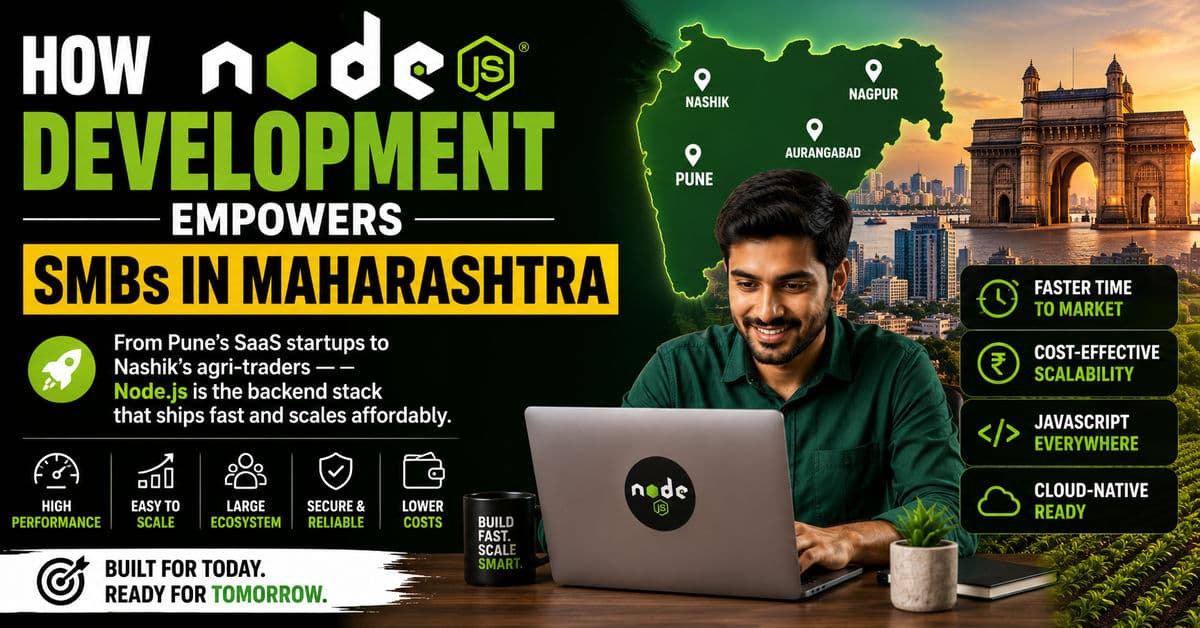
Maharashtra Runs on Hustle. Its Tech Stack Should Keep Up.
Maharashtra contributes over ₹35 lakh crore to India's GDP — the single largest state economy in the country. But strip away Mumbai's skyline and Pune's IT parks, and the engine behind that number is a massive network of small and medium businesses. Textile manufacturers in Ichalkaranji. Agri-commodity traders in Nashik. Auto-component suppliers clustered around Chakan. Wholesale distributors in Nagpur. SaaS startups bootstrapping out of Pune's Baner and Kothrud.
These businesses share a common pressure: they need to digitize operations, serve customers faster, and integrate with modern platforms — but they can't afford the timelines, budgets, or bloated architectures that enterprise software demands.
This is where the choice of backend technology stops being an abstract engineering decision and becomes a business-critical one. And for Maharashtra's SMBs — with their specific mix of high transaction volumes, multilingual customer bases, and tight margins — Node.js isn't just a reasonable option. It's the most practical foundation to build on.
Why the Backend Choice Matters More Than SMBs Think
Most SMB owners don't care about backend technology, and they shouldn't have to. What they care about is: can my system handle 500 concurrent users during a sale? Can I integrate Razorpay and GST invoicing without rewriting everything? Can my developer actually ship features in weeks, not quarters?
The backend stack directly determines the answers to all three questions.
Pick the wrong foundation — an outdated PHP monolith, a Java stack that needs three senior developers just to maintain, or a Python setup that buckles under concurrent requests — and you're either overspending on infrastructure, overspending on developer salaries, or both.
Node.js solves a specific set of problems exceptionally well, and those problems happen to align almost perfectly with what Maharashtra's SMBs actually need.
Speed to Market With a Single Language Stack
Node.js runs JavaScript on the server. Your frontend is already JavaScript. Your API layer is JavaScript. Your database queries through Prisma ORM — JavaScript. One language across the entire stack means one developer can work on everything.
For a 15-person SMB in Pune that can afford one or two developers — not a ten-person engineering team — this is transformative. You're not hiring a separate frontend developer, backend developer, and database specialist. You're hiring full-stack JavaScript developers who can build, debug, and ship across the entire application.
In Maharashtra's job market, this matters even more. Pune and Mumbai have the largest pool of JavaScript developers in western India. Finding competent Node.js talent at ₹5–10 LPA is significantly easier than finding equivalent Java or .NET developers, who command higher salaries and are harder to retain at SMB-level compensation.
Handling Concurrency Without Throwing Hardware at It
Here's a scenario every Maharashtra-based e-commerce or trading SMB recognizes: your traffic is moderate 90% of the time, but during festive sales — Diwali, Ganesh Chaturthi, end-of-season clearances — it spikes three to five times overnight.
Node.js handles this pattern better than most alternatives because of its event-driven, non-blocking architecture. Instead of creating a new thread for every incoming request (which is how traditional server frameworks work, and which eats memory linearly with traffic), Node.js processes requests asynchronously on a single thread using an event loop.
The practical result: a Node.js server running on a ₹2,000/month VPS can comfortably handle the same concurrent load that would require a ₹8,000–₹12,000/month setup on a thread-per-request architecture. For an SMB watching every rupee of infrastructure spend, that difference compounds fast.
Real Use Cases: Node.js Solving Maharashtra-Specific Business Problems
The Nashik Agri-Trader Who Needed Real-Time Price Updates
Agricultural commodity trading in Nashik and Ahmednagar operates on razor-thin margins where price information that's even thirty minutes stale can mean the difference between profit and loss. A mid-sized agri-trader was running their price tracking through a combination of phone calls, WhatsApp forwards, and a legacy desktop application that updated once an hour.
The Node.js solution: a lightweight WebSocket server that pushes real-time mandi price updates to the trading team's mobile devices. The same server integrates with their inventory system to auto-calculate margins based on current buy prices and committed sell orders.
Why Node.js was the right call here: WebSocket handling is native to Node.js. Building a real-time bidirectional communication layer that stays open and pushes updates is exactly the kind of I/O-intensive, low-computation workload that Node.js was designed for. Doing this in PHP would have required bolt-on libraries and constant workarounds. In Java, it would have worked but at twice the development time and infrastructure cost.
The Pune SaaS Startup That Needed an API-First Architecture
Pune's SaaS ecosystem is booming, but most early-stage startups make a critical architectural mistake: they build their product as a tightly coupled monolith because it's faster on day one. Six months later, when they need to ship a mobile app, integrate with a partner's system, or expose a public API for their enterprise clients, they discover they have to rebuild half the backend.
Node.js with Express or Fastify naturally encourages API-first design. Every route is an endpoint. Every business logic function can serve both your frontend and your mobile app through the same REST or GraphQL API. When the Pune startup needs to integrate with a client's ERP or expose webhooks for third-party automation, the architecture already supports it — no refactoring required.
This isn't a theoretical advantage. It's the difference between a Pune SaaS company closing an enterprise deal in their sixth month versus spending their sixth month rewriting their backend to support the integration the enterprise client requires.
The Mumbai Wholesale Distributor Managing Multi-Channel Orders
Wholesale distribution in Mumbai — whether it's electronics in Lamington Road or textiles in Mangaldas Market — increasingly runs across multiple channels simultaneously: walk-in orders, phone orders, a basic website, WhatsApp catalogue orders, and now B2B marketplace listings.
The chaos happens when each channel feeds into a different system or, worse, into the same overwhelmed Google Sheet. Orders get duplicated, inventory counts go out of sync, and someone spends two hours every evening reconciling the numbers.
A Node.js middleware layer acts as the single integration point. Every channel — website checkout, WhatsApp Business API webhook, manual POS entry — pushes orders into one processing pipeline. Inventory updates propagate in real-time. The distributor sees one dashboard, not five conflicting data sources.
Node.js excels here because middleware and API integration is its core strength. The npm ecosystem has production-ready packages for virtually every integration an Indian SMB needs: Razorpay for payments, WhatsApp Cloud API for messaging, GST API libraries for tax compliance, and ImageKit or Cloudinary for product images. You're assembling, not building from scratch.
The Maharashtra Developer Ecosystem Advantage
This point doesn't get discussed enough in stack selection conversations, and it should.
Maharashtra — specifically the Pune-Mumbai corridor — has arguably the deepest JavaScript talent pool in India outside Bangalore. Pune alone has hundreds of small development shops, freelancers, and bootcamp graduates who write JavaScript daily. The college ecosystem around Pune University, COEP, and the dozens of engineering colleges in the region produces developers who learn JavaScript first.
When you build your SMB's backend on Node.js, you're choosing a stack that your next hire already knows. You're not restricted to a niche talent pool of Elixir developers or Go specialists who can command premium salaries because supply is limited. You're tapping into the largest, most accessible developer market in western India.
This has a cascading effect on business operations. Developer turnover — which is brutal at SMB compensation levels — hurts less when replacements are readily available and can onboard quickly because the stack is familiar. Knowledge transfer is faster. Documentation requirements are lower. The bus factor improves.
For SMBs outside the Pune-Mumbai corridor — in Nagpur, Aurangabad, Kolhapur, Solapur — this advantage is even more pronounced. Finding a Python Django developer in Solapur is a challenge. Finding someone who can write JavaScript and learn Express in a week is significantly easier.
Where Node.js Fits in the Maharashtra SMB Tech Stack
The best Node.js setups for Indian SMBs aren't Node.js alone. They're a carefully chosen stack where each layer earns its place.
| Layer | Recommended Tool | Why It Works for Maharashtra SMBs |
|---|---|---|
| Backend Runtime | Node.js (Express or Fastify) | Fast, lightweight, massive ecosystem |
| Frontend Framework | Next.js 14 | Server-side rendering for SEO, API routes built-in |
| Database | PostgreSQL with Prisma ORM | Reliable, free, handles complex queries without licensing costs |
| Authentication | NextAuth.js or custom JWT | No per-user auth platform costs |
| Payments | Razorpay SDK | Built for India, GST-compliant, Node.js SDK is well-maintained |
| File Storage | ImageKit or Cloudinary | CDN-backed, pay-per-use, handles product images efficiently |
| Messaging | WhatsApp Cloud API | Direct integration, no third-party middleware required |
| Hosting | Railway or DigitalOcean | ₹1,500–₹5,000/month for production workloads |
Total monthly infrastructure cost for a production-ready SMB application on this stack: ₹3,000 to ₹10,000. Compare that to a .NET stack running on Azure with SQL Server licensing, or a Java stack on AWS with managed Elasticsearch — you're looking at three to five times the hosting bill for equivalent functionality.
When Node.js Is Not the Right Answer
I'd lose credibility if I pretended Node.js is the right choice for every SMB scenario. It isn't.
Heavy computational workloads — complex financial modelling, image processing pipelines, machine learning model training — are genuinely not Node.js territory. If your Maharashtra manufacturing SMB needs real-time statistical process control with heavy numerical computation, Python or Go will serve you better.
Extremely large monolithic applications that need strict type safety and enterprise-grade frameworks at scale are better served by Java or C#. If you're building a system that a hundred developers will maintain simultaneously, the guardrails those ecosystems provide matter more than Node.js's development speed.
But here's the thing: those scenarios describe a tiny fraction of Maharashtra's SMBs. The overwhelming majority need CRUD applications with good API design, real-time features, payment integrations, and the ability to ship fast and iterate without burning through their runway. That's the Node.js sweet spot, and it's exactly where most SMBs live.
The Cost of Waiting Is Higher Than the Cost of Building
Maharashtra's SMB landscape is shifting fast. The businesses digitizing their operations now — the Pune logistics company automating dispatch with a Node.js backend, the Nashik food processor tracking batches through a custom API, the Mumbai jeweller running an integrated online-offline inventory system — are pulling ahead of competitors who are still running on spreadsheets and phone calls.
The technology gap between digitized and non-digitized SMBs isn't closing. It's widening. And the longer you wait, the more expensive the transition becomes — not because the technology gets pricier, but because the operational debt of manual processes compounds every month.
Node.js won't solve every problem your Maharashtra SMB faces. But it will give you a backend foundation that ships fast, scales affordably, runs on infrastructure you can actually budget for, and taps into a developer pool deep enough that you're never stuck.
Build the system your business actually needs. Build it on a stack that respects your budget and your timeline. And build it now, because the competitor across the street probably already started.
Published by APXTECK — Node.js development and AI automation for Indian SMBs ready to digitize without the enterprise price tag. Explore our tech services → apxteck.com/services
Article Comments
You must be signed in to post comments.
Sign In to Join the Discussion →No comments approved yet. Be the first to share your thoughts!
About the Author

Praveen Kumar
Co-Founder & DirectorFull-Stack Developer, APXTECK, chatgpt, google
Praveen Kumar is the Co-Founder and Full-Stack Developer at APXTECK, an AI-powered IT agency helping Indian SMBs grow through web development, automation, and AI integration. He builds production-grade systems using Node.js, Next.js, PostgreSQL, and modern AI APIs. When he is not shipping code, he is writing about practical technology that actually works for Indian businesses.
Related Insights

Secret Psychology Behind High-Converting Coaching Interfaces

The SMB Guide to Scaling Down Enterprise Tech on a Budget

How Business Automation Saves 20+ Hours of Manual Work Weekly

Why Traditional SEO Is Dead: Preparing for Generative Search

Next.js ISR: The Real Weapon for Better Search Rankings

How to Architect a Multi-Tenant SaaS That Actually Scales

Mobile App Development for B2B Enterprise Software