

How AI Can Multiply Organic Traffic for Coaching Institutes

Praveen Kumar
How AI Can Multiply Organic Traffic for Coaching Institutes
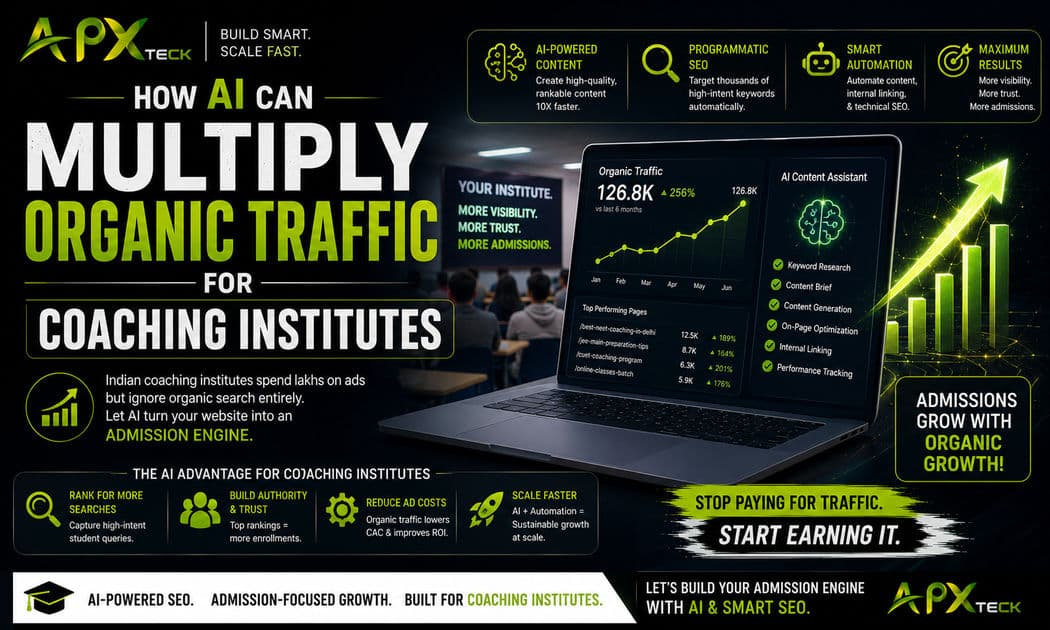
India's coaching institute market hit $7.2 billion in 2025 and is projected to reach $17.8 billion by 2034. There are thousands of institutes — JEE, NEET, UPSC, CAT, SSC, IELTS — all fighting for the same students. And almost all of them are fighting with the same weapon: paid ads.
Google Ads. Meta Ads. YouTube pre-rolls. Maybe some pamphlet distribution near colleges. The monthly ad spend climbs to ₹50,000, ₹1 lakh, ₹3 lakh — and the moment you stop paying, the leads stop coming. Meanwhile, the institute's website is a five-page brochure with a stock photo of a classroom, a phone number, and zero organic visibility.
This is the fundamental problem. Coaching institutes in India treat their website as a formality instead of what it should be: their single most valuable admission asset. And now, with AI tools that can generate targeted content at scale, build hundreds of optimized landing pages automatically, and capture leads around the clock — the institutes that figure this out will dominate organic search while their competitors keep burning money on ads.
Why Organic Traffic Is the Only Sustainable Admission Channel
Paid ads work — until they don't. The cost per click on education keywords in India has been rising steadily, and for competitive exam categories, you're paying ₹30-80 per click for traffic that converts at 2-5%. That means your cost per admission inquiry from ads alone can easily cross ₹1,500-3,000.
Organic search flips that equation entirely. Once your page ranks for "best NEET coaching in Jaipur" or "IIT JEE preparation tips for droppers," it sends you qualified traffic month after month at zero incremental cost. Around 70% of coaching website traffic in India comes from smartphones, and students searching on their phones have high intent — they're actively comparing institutes and ready to inquire.
The problem is that building organic traffic the traditional way — manually writing blog posts, slowly building backlinks, waiting 6-12 months for results — is too slow and too expensive for most coaching institutes. They don't have a dedicated content team. They don't have an SEO specialist. They have teachers who are busy teaching.
This is exactly where AI changes the game.
The AI-Powered Organic Traffic Playbook for Coaching Institutes
AI isn't one magic tool that fixes everything. It's a set of capabilities that, when applied strategically, can compress what used to take a 5-person marketing team 12 months into something a small institute can execute in 8-12 weeks. Here's the playbook.
Programmatic SEO: Hundreds of Targeted Pages, Built Automatically
This is the single highest-leverage AI strategy for coaching institutes, and almost nobody in the Indian education space is doing it properly.
Programmatic SEO means using structured data and templates to automatically generate large numbers of pages, each targeting a specific long-tail keyword. For a coaching institute, this looks like dedicated landing pages for every combination of exam, subject, city, and batch type that the institute serves.
Instead of one generic "Our Courses" page, you'd have individual, optimized pages for "NEET Biology coaching in Kota," "JEE Mains Physics crash course in Delhi," "UPSC prelims GS Paper 1 coaching in Lucknow," and dozens more. Each page follows a template but is populated with unique, relevant content — faculty profiles for that subject, batch schedules, syllabus coverage, past results for that exam category, and student testimonials.
Businesses with 40 or more landing pages generate 12 times more leads than those with fewer pages. For a coaching institute that serves multiple exams across multiple locations, the opportunity to scale from 5 pages to 200 pages is enormous — and AI makes the content generation for those pages economically viable.
The key is that these can't be thin, duplicate pages with just the city name swapped out. Google penalizes that. Each page needs unique value — and AI content generation tools can produce that differentiated content at scale when fed the right structured data (syllabus details, faculty bios, batch-specific information, local landmarks and competition context).
AI-Generated Educational Content That Ranks
Every student preparing for a competitive exam has hundreds of questions that they type into Google. "How to prepare for NEET in 6 months," "JEE Advanced vs JEE Mains difficulty comparison," "UPSC optional subject selection strategy," "best books for CAT quant preparation." These are long-tail, informational queries with high search volume and relatively low competition.
A coaching institute that publishes detailed, well-structured answers to these questions will capture that search traffic — and every visitor is a potential admission lead. The problem, again, is volume. A single institute can't manually write 200 blog posts covering every exam-prep question students are searching for.
AI solves the production bottleneck, but the approach matters. The winning formula is having subject-matter experts — your own faculty — provide the core knowledge, exam-specific insights, and unique tips. Then use AI to structure, expand, optimize, and format that expertise into SEO-ready content. AI handles the structure and scale; your faculty provides the credibility and depth that generic AI content can't match.
Research from Princeton and Georgia Tech found that content with specific statistics, cited sources, and clearly defined terms gets cited by AI search engines 3-6 times more than generic content. This matters because Google AI Overviews now appear on roughly 48% of all queries — and being cited in those overviews gives your institute visibility even when students don't click through to your site.
Schema Markup and Structured Data for AI Visibility
This is the most neglected technical lever in education SEO. Schema markup is structured code on your website that tells search engines exactly what your content represents — course details, fee structure, faculty credentials, student reviews, FAQs, event schedules.
For coaching institutes, the critical schema types are EducationalOrganization (identifying your institute to search engines), Course schema (for each program you offer, including duration, eligibility, and pricing), FAQ schema (turning your frequently asked questions into rich results), LocalBusiness schema (for each physical branch with address, phone, and hours), and Review schema (for student testimonials and ratings).
Implementing these takes a few hours of development work, but the payoff is significant. Studies show schema markup produces 89% more featured snippet appearances within 60 days and substantially more mentions in AI-generated search overviews. Most coaching institute websites in India have zero structured data — which means any institute that implements it immediately gains a technical edge.
AI Chatbots for 24/7 Lead Capture
Here's a scenario every coaching institute owner knows: a parent visits your website at 10 PM after their child's board exam results come out. They want to know about your JEE batch, fees, and next start date. Your office is closed. Your inquiry form asks for name, email, and phone — with no context, no interaction, no reason for the parent to feel confident.
That parent leaves your site and goes to your competitor who has a WhatsApp button.
An AI chatbot changes this entirely. Deployed on your website, it can answer common questions about courses, fees, schedules, and admission processes instantly — any time of day. It qualifies the inquiry by asking which exam, which year, which location. It captures contact details naturally as part of the conversation, not through a cold form. And it routes high-intent leads to your admissions team for immediate follow-up.
Visitors who engage with a chatbot are significantly more likely to convert — some studies show up to 5 times higher conversion rates from high-intent chatbot interactions compared to passive browsing. For a coaching institute where every admission inquiry matters, this is not a nice-to-have. It's a revenue multiplier.
The best part: modern AI chatbot platforms — trained on your specific course data, FAQs, and pricing — can be set up in 1-2 weeks and cost ₹2,000-10,000 per month. Compare that to your Google Ads spend.
Voice AI for Follow-Up and Re-engagement
This is the most underutilized AI channel in Indian education marketing: voice AI for automated follow-ups. A student fills out an inquiry form but never responds to your counselor's call. A parent downloaded your brochure but didn't register for the demo class.
An AI voice agent can make these follow-up calls automatically — in Hindi, English, or regional languages — confirm interest, answer basic questions, and book a counseling appointment. It handles the high-volume, repetitive follow-up work that your admission team either can't keep up with or does inconsistently.
For coaching institutes that receive 200-500 inquiries per month but have a 3-person admissions team, the gap between incoming leads and follow-through is where most revenue leaks happen. Voice AI plugs that gap without adding headcount.
What Most Coaching Institutes Get Wrong About Digital
Three fundamental mistakes that keep coaching institutes stuck in the ad-spend treadmill.
They Optimize for Brand Keywords They Already Own
If someone searches "Allen Career Institute Kota," they're going to find Allen regardless. Ranking for your own brand name is not SEO — it's a given. The traffic that grows your admissions comes from non-branded, intent-driven queries: "best medical coaching for repeaters," "NEET 2026 preparation strategy," "how to crack JEE in one year." That's where your content strategy should focus.
They Treat the Website as a Brochure, Not a Platform
Five static pages — Home, About, Courses, Results, Contact — is not a website strategy. It's a digital visiting card. A coaching institute website should be a content platform with dedicated pages for each course and location, a blog that answers every question students are searching for, a results section with structured data that search engines can parse, faculty profiles that build E-E-A-T (experience, expertise, authoritativeness, trustworthiness), and lead capture mechanisms on every high-intent page.
They Don't Measure What Matters
Most institutes track total website visits — a vanity metric. What actually matters is organic traffic by landing page (which pages attract students?), inquiry conversion rate per page (which pages turn visitors into leads?), keyword rankings for non-branded terms (are you visible for queries that bring new students?), and cost per admission inquiry from organic vs. paid (what's your actual ROI?). Without these metrics, you're flying blind. With them, every AI tool and content investment becomes measurable and optimizable.
The 90-Day Implementation Plan
If you run a coaching institute and want to start multiplying organic traffic with AI, here's a realistic roadmap.
Weeks 1-2: Audit your current website. Implement schema markup (EducationalOrganization, Course, FAQ, LocalBusiness). Fix technical SEO basics — page speed, mobile responsiveness, site structure. Set up Google Search Console and Analytics 4 properly.
Weeks 3-6: Build programmatic landing pages for your top exam-city-subject combinations. Use AI to generate differentiated content for each page, fed by your actual course data. Target 30-50 pages as a first batch. Deploy an AI chatbot trained on your course catalog and FAQs.
Weeks 7-12: Launch an AI-assisted content program — 8-12 blog posts per month targeting high-volume exam preparation queries. Each post should be reviewed and enriched by a subject-matter expert from your faculty. Set up voice AI for automated follow-up on unconverted inquiries.
Ongoing: Measure organic traffic growth weekly. Track inquiry conversions by page. Expand programmatic pages and content volume based on what's working. Iterate.
This isn't a ₹10 lakh agency retainer. The AI tools for content generation, chatbot deployment, and voice automation are accessible at ₹15,000-40,000 per month combined. The technical SEO setup is a one-time investment of ₹30,000-75,000 depending on your site's complexity. Compared to the ₹1-3 lakh most institutes spend monthly on ads alone, the ROI math is overwhelming — and the results compound instead of disappearing the moment you pause your budget.
The Window Is Open — But It Won't Stay Open
The Indian coaching market is moving fast. AI-driven personalization is growing at 15.89% CAGR in the online coaching segment alone. The institutes that build organic search moats now — through AI-generated content, programmatic SEO, and intelligent automation — will have a structural advantage that latecomers can't easily replicate. Content authority compounds. Backlinks accumulate. Rankings strengthen over time.
The question isn't whether AI can multiply organic traffic for coaching institutes. The research and the tools have already answered that. The question is whether your institute will be the one that acts on it, or the one still running the same Google Ads campaign next year wondering why the cost per lead keeps climbing.
Published by APXTECK — AI-powered web development, SEO, and automation for Indian businesses. Talk to us about growing your coaching institute's organic traffic →
Article Comments
You must be signed in to post comments.
Sign In to Join the Discussion →No comments approved yet. Be the first to share your thoughts!
About the Author

Praveen Kumar
Co-Founder & DirectorFull-Stack Developer, APXTECK, chatgpt, google
Praveen Kumar is the Co-Founder and Full-Stack Developer at APXTECK, an AI-powered IT agency helping Indian SMBs grow through web development, automation, and AI integration. He builds production-grade systems using Node.js, Next.js, PostgreSQL, and modern AI APIs. When he is not shipping code, he is writing about practical technology that actually works for Indian businesses.
Related Insights

How Healthcare Clinics Are Using Custom Software Development to Double Operational Efficiency

What Is GEO and Why It's the Next Big Frontier Beyond SEO

The ROI of Tech: Investing in IT Solutions That Actually Pay Off

Why Uber Burned Its Yearly AI Budget in Only Four Months

Mobile App Development for B2B Enterprise Software
Wearables, Data, and Dollars: The Business of Athlete Optimization

Stop Building Features, Start Building Value for Your SaaS