


The SMB Guide to Scaling Down Enterprise Tech on a Budget

Praveen Kumar
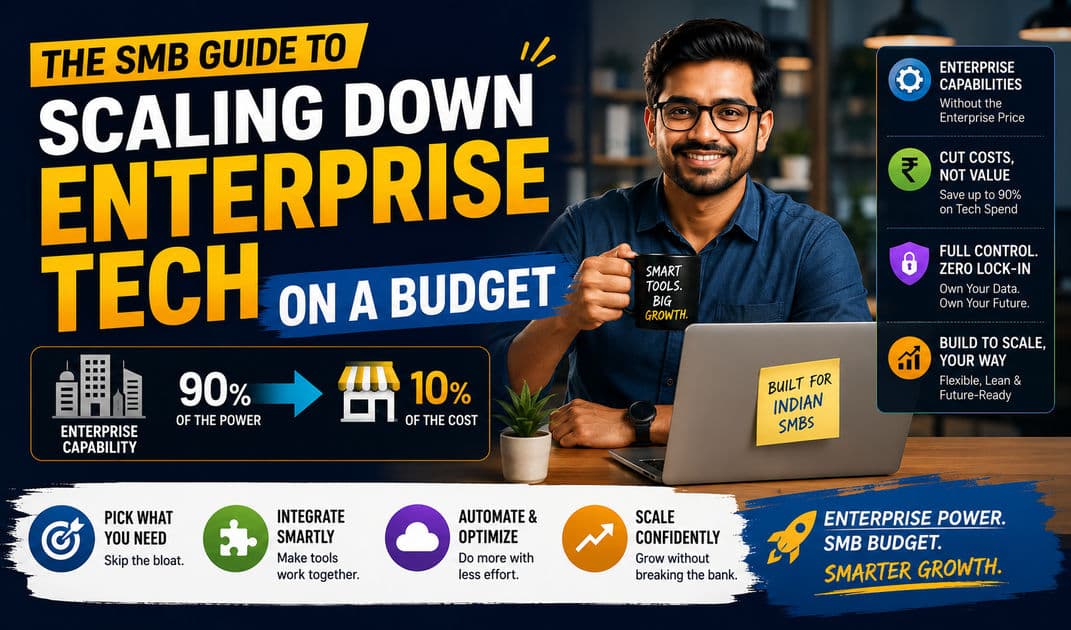
Enterprise Tech Has a Pricing Problem, Not a Capability Problem
There's a strange belief floating around Indian SMB circles that enterprise technology is fundamentally out of reach. That tools like proper CI/CD pipelines, observability dashboards, CRM systems with real automation, and managed databases are meant for companies with 500+ employees and IT budgets the size of a small town's GDP.
That belief is about five years out of date.
The reality in 2026 is that almost every category of enterprise software has a scaled-down version, an open-source alternative, or a generous free tier that covers exactly what a 10–50 person company needs. The problem isn't access — the problem is that most SMB owners don't know how to separate the 20% of enterprise tooling that actually matters from the 80% that exists to justify an enterprise sales team's commission.
This guide is about doing exactly that. Identifying the enterprise-grade capabilities your SMB genuinely needs, finding the most cost-efficient way to get them, and ruthlessly cutting everything else.
Why SMBs Even Need Enterprise-Grade Tech
Before diving into the how, let me address a pushback I hear constantly: "We're a 15-person company. Why do we need enterprise anything?"
Fair question. Wrong framing.
You don't need enterprise branding. You don't need enterprise dashboards with 47 unused widgets. But you absolutely need enterprise-level reliability, security, and automation — because your customers expect the same experience whether they're buying from you or from a company a hundred times your size.
Your Customer Doesn't Care About Your Headcount
A D2C brand in Jaipur with 12 employees still has customers who expect order confirmations within seconds, accurate tracking updates, and responsive support. A SaaS startup in Bangalore with 20 engineers still has clients who expect 99.9% uptime and data security that meets compliance standards.
Enterprise tech isn't about looking big. It's about running tight operations that don't fall apart when volume spikes or when one person goes on leave. The tools exist. The mistake is buying the ₹50,000/month version when the ₹3,000/month version does the same job for your scale.
The Enterprise-to-SMB Translation Framework
Here's how I think about scaling down enterprise tech, and this framework has saved multiple clients lakhs per year.
Every enterprise tool solves a problem across three layers: the core function (what it actually does), the scale layer (handling massive volume, teams, and compliance), and the enterprise wrapper (SSO, advanced admin controls, audit logs, dedicated account managers, and custom SLAs). SMBs need the core function. They occasionally need parts of the scale layer. They almost never need the enterprise wrapper — and that wrapper is where 60–70% of the pricing sits.
The entire game is stripping the wrapper, keeping the core, and selectively picking scale features only when your business genuinely demands them.
Category-by-Category Breakdown: What to Use and What to Skip
CRM and Sales Pipeline
The enterprise default is Salesforce. A single Salesforce Enterprise license runs ₹13,000–₹25,000/user/month. For a 10-person sales team, that's ₹1.5L–₹3L/month on CRM alone. Most SMBs using Salesforce touch about 15% of its features and spend more time fighting its configuration than actually selling.
| Option | Monthly Cost (10 Users) | Best For |
|---|---|---|
| Salesforce Enterprise | ₹1.3L – ₹2.5L | Companies that actually need CPQ, territory management, and Apex customization |
| Zoho CRM Professional | ₹12,000 – ₹18,000 | Indian SMBs who want a solid, affordable CRM with native Indian payment and GST integrations |
| Twenty (Self-Hosted, Open Source) | ₹2,000 – ₹5,000 (hosting only) | Tech-savvy teams who want full control and zero per-seat costs |
| Custom-Built Pipeline | ₹3L – ₹5L one-time + ₹3K–₹5K/month hosting | Businesses with unique sales workflows that no off-the-shelf tool handles well |
The honest recommendation for most Indian SMBs doing ₹1–10 Cr revenue: Zoho CRM Professional or a custom pipeline. Salesforce makes sense only when you genuinely need its advanced automation rules, and you'll know when you do because Zoho will start actively limiting you.
Project Management and Collaboration
Enterprise companies default to Jira and Confluence. Annual costs for even modest teams spiral quickly — and Jira's interface has become so complex that half the team avoids it entirely, which defeats the purpose.
For SMBs, the question is simpler: do you need issue tracking, or do you need full agile project management with sprint planning, backlog grooming, and velocity charts?
If the answer is issue tracking — and for 80% of SMBs, it is — Linear's free tier or Plane (open source, self-hostable) handles everything you need. If you genuinely run sprints and need boards, Plane gives you a Jira-quality experience without the licensing cost.
If the answer is "we just need to know who's doing what this week," stop overthinking it. A well-organized Notion workspace or even a structured Telegram group with pinned tasks works. Not every problem needs a dedicated tool.
Observability and Monitoring
This is where SMBs either spend too much or — more dangerously — spend nothing.
Datadog, the enterprise default, is extraordinary. It's also priced to extract maximum revenue from every host, metric, and log line you ingest. A mid-sized deployment can hit ₹50,000–₹1L/month before you've even configured custom dashboards.
The scaled-down playbook:
For application monitoring, use Sentry's developer tier. Free for up to 5,000 errors/month, which covers most SMB workloads comfortably. For uptime monitoring, BetterStack (formerly Better Uptime) has a free plan that monitors multiple endpoints with incident alerts. For log management, if your application generates modest log volume, Grafana Cloud's free tier with Loki handles structured logging without the per-GB pricing nightmare of enterprise log platforms.
The key insight: enterprise observability platforms bundle everything — metrics, traces, logs, synthetics, real-user monitoring — into one bill. SMBs can unbundle and pick best-of-breed free tiers for each layer, getting 90% of the visibility at a fraction of the cost.
Database and Infrastructure
Here's where I get opinionated, because this is where bad decisions cost the most.
Enterprise companies default to managed databases with enterprise support contracts — AWS RDS with multi-AZ failover, dedicated instances, and reserved capacity pricing. The costs compound fast. A single db.r6g.xlarge RDS instance with multi-AZ runs approximately ₹40,000–₹60,000/month before storage and I/O charges.
For most Indian SMBs running PostgreSQL workloads, Supabase's Pro plan at $25/month (roughly ₹2,100) or Railway's usage-based pricing gives you a managed PostgreSQL instance with automatic backups, connection pooling, and enough headroom to handle significant traffic before scaling becomes a concern.
The enterprise features you're skipping — multi-AZ failover, read replicas, cross-region replication — matter when your database handles thousands of writes per second. If your application processes a few hundred concurrent users, a single well-tuned managed instance is more than enough. You can always upgrade later when revenue justifies the cost.
AI and Automation
This category is the biggest equalizer between enterprise and SMB in 2026, and most SMBs haven't woken up to it yet.
Enterprise companies spend ₹10–50L/year on automation platforms like UiPath, Automation Anywhere, or custom ML pipelines with dedicated data engineering teams. These are powerful, mature systems — and wildly oversized for what a 20-person company needs.
The scaled-down alternative stack looks like this: use OpenAI or Gemini APIs directly for document processing, content generation, classification, and summarization. Build workflow automations using n8n (self-hosted, open source) instead of paying per-task prices on Zapier or Make. Use ElevenLabs or Play.ht for voice AI at API pricing instead of licensing enterprise call center platforms.
The per-unit costs on AI APIs are so low now that an SMB can run intelligent document processing, automated customer responses, and AI-assisted internal reporting for ₹3,000–₹8,000/month in total API spend. That same capability would've cost ₹5–10L/year in enterprise licensing three years ago.
The Three Rules of Budget Enterprise Tech
Rule 1: Never Pay for Users You Don't Have
Per-seat pricing is the single biggest drain on SMB tech budgets. Enterprise vendors price per seat because they sell to companies with thousands of employees. When a 15-person company buys into a per-seat model at ₹2,000/user/month, they're subsidizing the infrastructure that the vendor built for customers ten times their size.
Wherever possible, choose tools with flat-rate pricing, usage-based pricing, or self-hosted open-source alternatives with zero per-seat costs. The math difference over 24 months is staggering.
Rule 2: Self-Host Only What You Can Maintain
Open-source and self-hosted tools save money. They also create maintenance overhead — updates, security patches, backup monitoring, and the occasional 2 AM outage that someone has to fix.
Be realistic about your team's bandwidth. Self-host tools that are stable and low-maintenance (like Plane for project management or n8n for workflow automation). Use managed services for anything where downtime directly costs you revenue (databases, email infrastructure, payment processing). The savings from self-hosting your database are meaningless if a failed backup costs you a week of customer data.
Rule 3: Consolidate Before You Optimize
Before hunting for cheaper alternatives to each of your twelve SaaS subscriptions, step back and ask: how many of these tools are doing overlapping jobs?
Most SMBs accumulate tools reactively — a new problem surfaces, someone signs up for a tool, and six months later nobody remembers why they have three different platforms that all handle task assignments. The cheapest tech is the tool you eliminate entirely by consolidating its function into something you're already paying for.
The Trap of "Free Tier Forever" Thinking
One caveat before I close. Scaling down enterprise tech doesn't mean squeezing everything into free tiers and refusing to pay for anything. That strategy has a ceiling, and it usually hits right when your business starts growing — which is the worst possible time to discover that your free-tier monitoring doesn't alert you to outages, or your free-tier database doesn't support the connection count your new traffic demands.
Budget enterprise tech means paying strategically. Spend on the tools that directly protect revenue (database reliability, payment infrastructure, security). Be aggressive about cost-cutting on everything that's operational convenience rather than business-critical (project management, internal documentation, analytics dashboards).
The companies that get this balance right run leaner operations than competitors twice their size — and they have the margins to prove it.
Stop Overpaying. Stop Underbuilding.
The enterprise tech landscape has democratized faster than most Indian SMBs realize. The tools your ₹500 Cr competitor uses are available to you — maybe not the exact SKU, but the same core capability, at a price point that makes sense for your revenue.
The playbook is straightforward: strip the enterprise wrapper, keep the core function, self-host where your team can handle maintenance, use managed services where reliability is non-negotiable, and consolidate ruthlessly before adding anything new.
You don't need a CTO and a ₹50L annual IT budget to run enterprise-grade operations. You need a clear understanding of what you actually require, the discipline to skip what you don't, and a tech partner who builds for SMB reality — not enterprise fantasy.
Published by APXTECK — helping Indian SMBs run enterprise-grade tech at SMB-friendly budgets. Talk to us → apxteck.com/contact
Article Comments
You must be signed in to post comments.
Sign In to Join the Discussion →No comments approved yet. Be the first to share your thoughts!
About the Author

Praveen Kumar
Co-Founder & DirectorFull-Stack Developer, APXTECK, chatgpt, google
Praveen Kumar is the Co-Founder and Full-Stack Developer at APXTECK, an AI-powered IT agency helping Indian SMBs grow through web development, automation, and AI integration. He builds production-grade systems using Node.js, Next.js, PostgreSQL, and modern AI APIs. When he is not shipping code, he is writing about practical technology that actually works for Indian businesses.
Related Insights

Secret Psychology Behind High-Converting Coaching Interfaces

How Node.js Development Empowers SMBs in Maharashtra

How Business Automation Saves 20+ Hours of Manual Work Weekly

Why Traditional SEO Is Dead: Preparing for Generative Search

Next.js ISR: The Real Weapon for Better Search Rankings
How to Architect a Multi-Tenant SaaS That Actually Scales

Mobile App Development for B2B Enterprise Software