


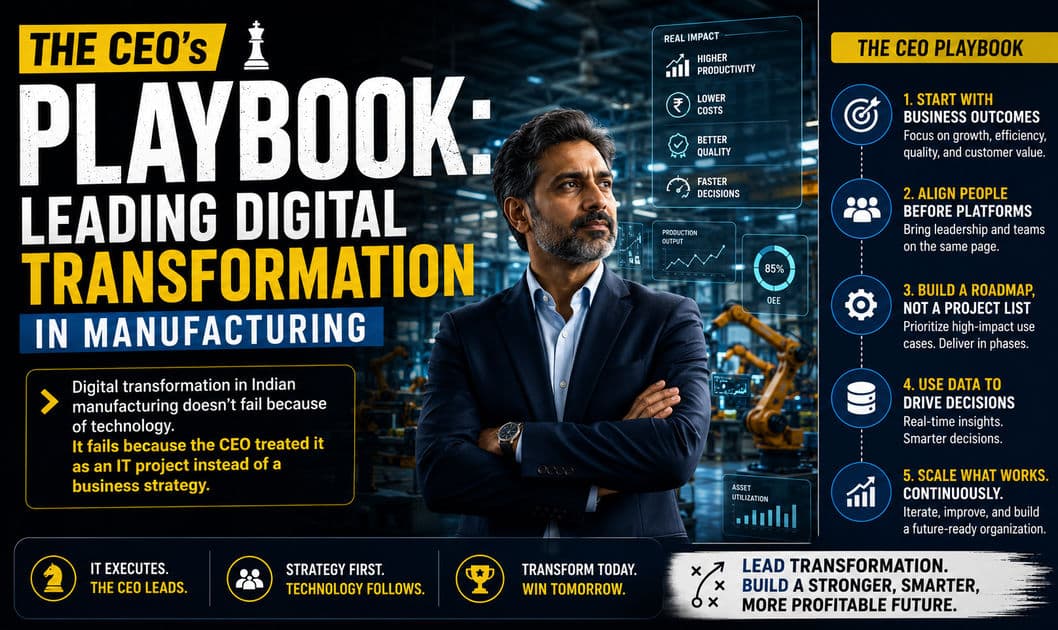
The CEO's Playbook: Leading Digital Transformation in Manufacturing

Praveen Kumar
The ₹40 Lakh ERP Graveyard Nobody Talks About
Somewhere in an industrial estate in Faridabad, a ₹80 Cr auto-component manufacturer has a ₹40 lakh ERP system that exactly three people in the company know how to use. Production managers still track daily output on whiteboards. Quality inspection data lives in physical registers. Purchase orders go through the ERP on paper — meaning someone generates a handwritten PO, and another person enters it into the system hours later so the software "has the data."
This isn't an outlier. This is the median outcome of digital transformation in Indian manufacturing.
The CEO bought the vision. The vendor delivered the software. The implementation ran over budget and over timeline. The shop floor rejected it because nobody consulted them. And eighteen months later, the company is running the same manual processes it always ran — just now with an expensive piece of software sitting on top that generates reports nobody reads.
Digital transformation in manufacturing doesn't fail because the technology is wrong. It fails because the CEO delegated it to IT, approved a budget, and moved on. Transformation isn't an IT project. It's a business reorganization that happens to use technology — and it requires the CEO to lead it with the same intensity they'd bring to entering a new market or restructuring the supply chain.
Why Manufacturing CEOs Get This Wrong More Than Any Other Sector
Manufacturing leaders are operationally brilliant. They understand throughput, yield, procurement cycles, and labour management at a granular level most tech executives would struggle with. But that operational depth creates a specific blind spot when it comes to digital transformation.
The "System Will Fix It" Fallacy
Most manufacturing CEOs approach digitization the way they approach buying a new CNC machine. Identify the problem, evaluate vendors, purchase the solution, install it, train people, done. The machine works because it does a defined physical task. Plug it in, calibrate it, run it.
Software doesn't work like that. An ERP doesn't produce value by being installed. It produces value only when every process it touches changes to flow through it — and when the people involved in those processes actually trust and use it. The machine analogy breaks down completely, but manufacturing CEOs keep applying it because it's the mental model they know best.
The Delegation Trap
In a manufacturing setup, the CEO typically has a strong production head, a trusted finance person, and — if the company is large enough — an IT manager or outsourced IT vendor. When digital transformation comes up, the natural instinct is to hand it to the IT person.
This is the single most reliable way to guarantee failure.
The IT manager doesn't have the authority to change how the purchase department raises orders. They can't redesign the quality inspection workflow without the plant head's buy-in. They can't insist that the sales team enters orders into a system instead of calling the factory directly. Every meaningful process change requires cross-functional authority that only the CEO has.
When the CEO delegates transformation to IT, they're asking someone with technical skills but no organizational power to restructure how the entire company operates. The result is predictable: the IT team builds or configures the system correctly, the rest of the company ignores it, and the CEO blames the technology.
The Playbook: Four Phases That Actually Work
What follows isn't theory. It's a sequence distilled from watching Indian manufacturers — ₹10 Cr to ₹200 Cr in revenue — attempt digital transformation, and identifying the patterns that separate the ones that succeed from the ones that end up with expensive shelfware.
Phase 1: Diagnose the Process, Not the Technology Gap
Before evaluating a single piece of software, the CEO needs to personally map the company's five most critical workflows end-to-end. Not review a flowchart someone else drew — physically walk the process.
Follow a customer order from the moment it arrives to the moment the product ships. Count the handoffs. Count the points where information moves from one format to another — verbal to WhatsApp to register to spreadsheet to ERP. Count the decisions that depend on someone's memory rather than accessible data.
Most manufacturing CEOs who do this exercise are shocked. They discover that a process they assumed had four steps actually has fourteen — nine of which are unofficial workarounds that the shop floor invented because the official process doesn't match how work actually flows.
This diagnosis matters because digital transformation isn't about digitizing your current process. It's about eliminating the broken steps, simplifying the necessary ones, and only then building technology around the streamlined workflow. Automating a broken process just gives you faster, more consistent broken output.
CEO action: Block two full days. Walk the floor. Follow five key processes personally. Document every handoff, every format change, every manual workaround. Do this before talking to a single vendor.
Phase 2: Pick One Workflow. Transform It Completely.
The most common mistake is launching digital transformation across the entire company simultaneously. New ERP for finance, new MES for production, new CRM for sales, new HRMS for people — all at once, all with different vendors, all requiring training at the same time.
The shop floor, already resistant to change, gets overwhelmed. The finance team, already stretched thin during month-end closes, resents the additional burden. Everyone reverts to old habits within weeks, and the CEO is left wondering why a ₹30 lakh investment produced zero change.
The playbook that works is surgical. Pick one workflow — the one with the highest pain, the most manual hours, and the most direct impact on either revenue or cost — and transform it completely.
For most Indian manufacturers, the highest-impact starting points fall into three categories:
| Starting Point | When to Pick It | Expected Impact |
|---|---|---|
| Order-to-dispatch workflow | Frequent order errors, missed delivery dates, customer complaints about status visibility | 20–30% reduction in order processing time; measurable improvement in on-time delivery |
| Quality inspection and traceability | Customer rejections are rising, manual registers make root-cause analysis impossible, compliance audits are painful | Real-time defect tracking, batch traceability, 40–60% faster audit preparation |
| Purchase and inventory management | Frequent stock-outs or overstocking, purchase decisions based on gut rather than consumption data | 15–25% reduction in inventory carrying cost, elimination of emergency purchases |
Pick one. Not two. One.
Transform it end-to-end — from the trigger event to the final output — so that the entire flow runs digitally without paper fallbacks. Make it work flawlessly for 60 days. Let the rest of the company see the results. Then — and only then — move to the second workflow.
This approach works because success is visible. When the purchase team sees that the production team's digitized inspection workflow caught a quality issue in real-time that would have previously reached the customer, they stop resisting and start asking when their process gets digitized.
CEO action: Choose the single most painful workflow. Assign it a dedicated owner (not IT — a process owner from the business side). Set a 90-day deadline for full digital operation of that one workflow.
Phase 3: Build the Data Layer Before the Dashboard
Every manufacturing CEO wants a dashboard. Real-time production output. Rejection rates. Machine utilization. OEE numbers updating live on a screen in the corner office.
The dashboard is the least important part of the transformation.
The important part is the data layer underneath — the systems, sensors, and processes that capture accurate, real-time data from the shop floor. Without clean data flowing consistently, the dashboard is just a screen displaying garbage in a visually appealing format.
Building the data layer means answering hard questions. How does production data currently get recorded? If an operator notes output on a paper sheet at shift end, your "real-time dashboard" is actually showing 8-hour-old data with a live-updating clock. If quality inspection results are entered into a system retroactively — after the batch has already moved to the next stage — your traceability system has a gap that makes it useless for catching defects in time.
The data layer for a manufacturing SMB doesn't require IoT sensors on every machine or a ₹50 lakh SCADA system. For most Indian manufacturers, the pragmatic starting point is:
Simple digital data capture at the point of activity — a tablet or rugged smartphone at each workstation where the operator logs output, rejects, and downtime reasons as they happen, not at shift end. Integration between that capture layer and a central database (PostgreSQL handles this at negligible cost). Automated validation rules that flag anomalies in real-time — a rejection rate spike, an output drop, a machine that's been marked "down" for longer than usual.
Once this layer works reliably and consistently — meaning data flows in real-time without manual re-entry — the dashboard builds itself. The hard part was never the visualization. It was getting trustworthy data into the system in the first place.
CEO action: Before approving any dashboard project, ask one question: "Where does the data come from, and how old is it when it reaches the screen?" If the answer involves manual entry, batch uploads, or shift-end reporting, fix the data capture first.
Phase 4: Make the Change Irreversible
This is where most transformations quietly die — not in a dramatic failure, but in a gradual drift back to old habits.
The production manager who was using the new system starts keeping a parallel paper register "just in case." The purchase head who was entering POs digitally starts making phone calls again because "it's faster for urgent orders." Within six months, the company is running dual processes — digital and manual simultaneously — which is worse than either one alone because it doubles the workload without any of the benefits.
The CEO's job in this phase is to make the old process impossible to return to.
Remove the physical registers from the shop floor. Disable the shared spreadsheets that were used for tracking before. Change approval workflows so that purchase orders that don't originate from the system don't get signed. Make the digital process the only path — not the preferred path, not the recommended path, the only path.
This sounds aggressive. It is. And it's the only approach that works in Indian manufacturing environments where the gravitational pull toward established habits is extraordinarily strong. People revert to old processes not because the new system is bad, but because the old way is familiar and comfortable. Comfort will always win over efficiency unless the comfortable option is physically removed.
CEO action: Set a hard cutoff date — typically 30 days after the digital process is proven stable — after which the old process is decommissioned. Not optional. Not gradual. Decommissioned.
The Technology Decisions the CEO Should Actually Make
Most manufacturing CEOs over-involve themselves in technology selection (spending weeks evaluating ERP vendors) and under-involve themselves in technology strategy (never deciding what the company's digital architecture should look like in three years).
The CEO shouldn't be comparing feature matrices of SAP versus Oracle versus Tally. The CEO should be making three strategic decisions that shape every technology choice downstream.
Decision 1: Build Custom vs. Buy Packaged
For Indian manufacturers between ₹10 Cr and ₹100 Cr, this decision is more nuanced than vendors would have you believe.
| Factor | Packaged Software (ERP/MES) | Custom-Built System |
|---|---|---|
| Time to deploy | 6–18 months with customization | 3–6 months for core workflows |
| Upfront cost | ₹10L – ₹50L+ (licenses + implementation) | ₹3L – ₹12L (development) |
| Ongoing cost | Annual maintenance 18–22% of license cost | Hosting ₹3K–₹10K/month + developer as needed |
| Process fit | You adapt your process to the software | Software is built around your actual process |
| Scalability risk | Vendor lock-in; migration is painful and expensive | You own the code; switch developers without losing the system |
| Best for | Companies with standard manufacturing workflows that match the ERP's assumptions | Companies with unique workflows, hybrid operations, or non-standard supply chains |
The honest answer for most Indian manufacturing SMBs: a hybrid approach. Use packaged software for standardized functions — accounting (Tally/Zoho Books), statutory compliance (GST filing), basic HRMS — and build custom systems for the operational workflows that differentiate your business and don't fit neatly into any vendor's template.
Decision 2: Cloud vs. On-Premise
In 2026, this should barely be a debate, but it still is in Indian manufacturing because of two persistent concerns: internet reliability at factory locations and data security fears.
Internet reliability is a legitimate concern for factories in industrial areas with inconsistent connectivity. The solution isn't avoiding cloud — it's building with an offline-first architecture where the local application works without internet and syncs data when connectivity is available. This pattern is well-established and handles the 30-minute connectivity gaps that occur in Indian industrial zones without data loss.
Data security fears are mostly unfounded at the SMB level. A managed PostgreSQL database on a reputable cloud provider (AWS, DigitalOcean, Railway) is orders of magnitude more secure than a server sitting under a desk in the factory's admin office, maintained by nobody, backed up never. The cloud provider handles encryption, patching, backups, and access controls — all of which the average Indian manufacturing SMB has zero internal capability to manage.
Decision 3: AI Now or AI Later
This is the decision where manufacturing CEOs are leaving the most value on the table.
Most Indian manufacturers think of AI as futuristic — something for automotive giants and pharma multinationals. That perception is three years out of date.
Practical AI for manufacturing SMBs in 2026 looks like this: automated document processing that reads purchase orders, extracts line items, and creates entries in your system without manual data entry. Quality inspection using computer vision that catches surface defects faster and more consistently than visual inspection by fatigued operators at hour six of their shift. Demand forecasting based on historical order patterns that reduces both stock-outs and excess inventory.
The costs are surprisingly accessible. An AI-powered document processing pipeline using OpenAI or Gemini APIs costs ₹2,000–₹5,000/month in API usage for typical SMB volumes. Computer vision inspection using edge devices starts at ₹1–2L per station. Demand forecasting models built on your historical data cost a one-time ₹2–4L to develop and negligible amounts to run.
The CEO's decision isn't whether to use AI — it's which manual process has the highest error rate and the most volume, because that's where AI delivers the fastest payback.
What the CEO's Weekly Involvement Should Look Like
Digital transformation doesn't need the CEO full-time. It needs the CEO consistently — every week, without gaps — for the duration of each phase.
Fifteen minutes every Monday morning. Review three metrics: adoption rate (is the team actually using the new system or falling back to manual?), data quality (are entries complete, timely, and accurate?), and blockers (what's stopping the next phase from starting?).
The CEO doesn't need to understand the technology. They need to understand whether the humans in the organization are changing their behaviour. Because the technology, configured correctly, will work. The question is always whether the organization lets it.
If adoption drops, the CEO investigates why — personally, on the shop floor, not through reports filtered through three management layers. If data quality drops, the CEO finds the specific step where data entry is being skipped and fixes the process or the incentive. If a blocker is political — one department head resisting because the new system makes their workaround visible — the CEO resolves it with the authority only they have.
This isn't micromanagement. It's leadership. And it's the single factor that separates the Indian manufacturers who successfully digitize from the ones who have ₹40 lakh of unused software collecting dust.
The Manufacturer Who Gets This Right Wins the Decade
Indian manufacturing is entering a period where the gap between digitized and non-digitized operations will become a competitive chasm. The manufacturer who has real-time production data makes faster decisions. The manufacturer with automated quality traceability wins the export compliance audit. The manufacturer whose order-to-dispatch cycle is 40% shorter takes the customer from the competitor who's still processing orders through WhatsApp and paper registers.
Digital transformation isn't a technology investment. It's a leadership commitment with technology as the vehicle. The CEO who understands this — who leads from the front, picks one battle at a time, demands clean data before pretty dashboards, and makes the change irreversible — builds a manufacturing operation that compounds its advantages every quarter.
The CEO who hands it to IT and checks back in six months gets a very expensive lesson in how not to spend ₹40 lakhs.
Start with one workflow. Walk the floor. Own the change. The technology will follow.
Published by APXTECK — we build custom digital systems for Indian manufacturers who are done with shelfware and ready for transformation that sticks. Let's talk → apxteck.com/contact
Article Comments
You must be signed in to post comments.
Sign In to Join the Discussion →No comments approved yet. Be the first to share your thoughts!
About the Author

Praveen Kumar
Co-Founder & DirectorFull-Stack Developer, APXTECK, chatgpt, google
Praveen Kumar is the Co-Founder and Full-Stack Developer at APXTECK, an AI-powered IT agency helping Indian SMBs grow through web development, automation, and AI integration. He builds production-grade systems using Node.js, Next.js, PostgreSQL, and modern AI APIs. When he is not shipping code, he is writing about practical technology that actually works for Indian businesses.
Related Insights

How Blinkit's Free Ambulance Became Its Best Marketing Move

GPT-6 Astra: OpenAI’s New AI Model Could Change Software Development and Business Work

AI-Powered Cyberattacks Are Rising: Why Every Business Needs Stronger Cybersecurity Now

How Next.js and Generative Search Help Builders Win Leads

Build Your Own Food Delivery App: Stop Giving Your Profits to Swiggy & Zomato

How to Hire the Right Business Automation Without Burning Your Seed Capital

Zomato's Notifications Work. Copying Them Will Hurt You.