


Lightning-Fast Websites with Premier Next.js Development

Praveen Kumar
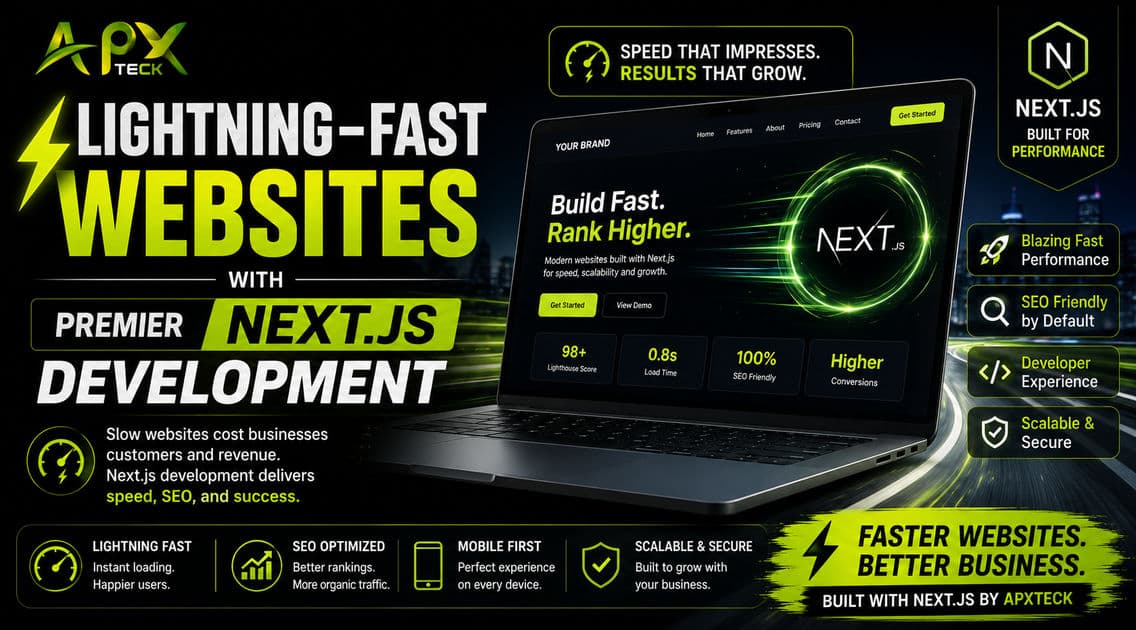
Lightning-Fast Websites with Premier Next.js Development
Your website has less than three seconds to make a first impression. Miss that window, and potential customers may leave before they even see what you offer.
For many businesses, the biggest problem isn't poor design or weak marketing—it's website performance. Slow-loading pages, poor Core Web Vitals, and low search rankings quietly reduce leads, sales, and customer trust every day.
This is why businesses that care about growth are moving beyond traditional website development and investing in Premier Next.js Development. Built by the creators of React, Next.js combines speed, scalability, and SEO into a single framework that powers websites for startups, enterprises, and global brands alike.
If your goal is to build a website that loads quickly, ranks well on search engines, and delivers a premium user experience, Next.js should be at the top of your technology shortlist.
Why Website Speed Matters More Than Ever
Website speed is no longer just a technical metric—it directly impacts business performance.
A slow website can lead to:
Higher bounce rates
Lower Google rankings
Reduced customer trust
Poor mobile experience
Fewer inquiries and conversions
For businesses investing in SEO, paid advertising, or social media marketing, a slow website means paying to bring visitors who leave before engaging.
Fast websites create a better first impression, encourage users to explore more pages, and improve the likelihood of converting visitors into customers.
What Makes Next.js Different?
Next.js is a React framework designed to build modern web applications with performance and scalability in mind.
Unlike traditional client-side React applications, Next.js offers multiple rendering strategies that improve both speed and search engine visibility.
Key capabilities include:
Server-Side Rendering (SSR)
Static Site Generation (SSG)
Incremental Static Regeneration (ISR)
Server Components
Built-in Image Optimization
API Routes
Middleware
Advanced Routing with the App Router
These features allow developers to build websites that are fast without sacrificing functionality.
How Next.js Improves Website Performance
Server-Side Rendering for Faster First Loads
Instead of asking the browser to build the page after loading JavaScript, Next.js can render content on the server before sending it to the user.
Benefits include:
Faster initial page loads
Better user experience
Improved SEO
Reduced waiting time on slower networks
This is especially valuable for business websites where visitors expect immediate access to information.
Automatic Image Optimization
Large, unoptimized images are one of the biggest causes of slow websites.
Next.js automatically:
Compresses images
Serves modern formats where supported
Delivers responsive image sizes
Lazy-loads off-screen images
The result is faster page loads without sacrificing visual quality.
Better SEO Out of the Box
Search engines need to understand your content before they can rank it.
Because Next.js can render pages on the server, search engines receive fully populated HTML instead of waiting for JavaScript execution.
This helps improve:
Indexing speed
Search visibility
Rich metadata support
Social sharing previews
Organic traffic potential
For businesses competing in crowded markets, these advantages can make a measurable difference.
Traditional React vs Next.js
| Feature | Traditional React | Next.js |
|---|---|---|
| SEO Support | Limited | Excellent |
| Initial Load Speed | Moderate | Fast |
| Image Optimization | Manual | Built-In |
| Routing | External Library | Native |
| Server Rendering | Requires Setup | Built-In |
| Performance Optimization | Manual | Automatic |
| API Development | Separate Backend | Supported |
| Scalability | Good | Excellent |
For content-heavy websites, service businesses, SaaS platforms, and e-commerce stores, Next.js often provides a more complete solution.
Why Businesses Choose Next.js Development
Improved Search Rankings
A technically optimized website gives search engines a better experience, supporting long-term organic growth alongside quality content.
Higher Conversion Rates
Faster websites reduce friction in the customer journey. Visitors are more likely to complete forms, request quotes, or make purchases when pages respond quickly.
Better Mobile Performance
In India, a large share of web traffic comes from mobile devices. Next.js helps deliver consistent performance across smartphones, tablets, and desktops, even on slower connections.
Easier Scalability
Whether you're launching with ten pages or planning thousands of dynamic routes, Next.js is built to scale as your business grows.
Real-World Business Use Cases
Next.js is well suited for a wide range of industries, including:
Healthcare
Online appointment booking
Patient portals
Doctor profiles
Diagnostic reports
Real Estate
Property listings
Interactive search
Lead generation forms
Location-based pages
Manufacturing
Product catalogues
Distributor portals
Inquiry management
Technical documentation
SaaS Platforms
Marketing websites
Customer dashboards
Authentication
Subscription management
E-commerce
Product pages
Fast checkout experiences
Inventory integration
SEO-friendly category pages
Why Custom Next.js Development Beats Website Builders
Website builders are useful for simple projects, but they become restrictive as businesses grow.
| Website Builder | Custom Next.js Development |
|---|---|
| Fixed Templates | Fully Custom Design |
| Limited Features | Unlimited Flexibility |
| Plugin Dependency | Tailored Integrations |
| Basic Performance | Optimized Performance |
| Vendor Lock-In | Full Ownership |
| Limited Scalability | Enterprise Ready |
If your website plays a central role in lead generation or customer engagement, investing in a custom solution provides greater long-term value.
Essential Features of a Modern Next.js Website
A professionally built Next.js website should include:
Responsive design
Fast loading pages
SEO-friendly architecture
Secure authentication
CMS integration
Contact and lead forms
Analytics integration
Performance monitoring
API connectivity
Cloud deployment
Accessibility best practices
These features help ensure your website performs well for users and remains maintainable as your business evolves.
Choosing the Right Next.js Development Partner
Technology is only one part of a successful project.
Your development partner should also understand:
Business objectives
User experience
Search engine optimization
Performance optimization
Security
Scalable backend architecture
Ongoing maintenance and support
A well-planned project considers both technical excellence and measurable business outcomes.
Invest in Performance, Not Just Design
An attractive website that loads slowly still loses customers. Modern businesses need websites that combine speed, usability, and search visibility to stay competitive.
Next.js provides the technical foundation to build those experiences, but the real value comes from implementing it strategically around your business goals. Whether you're launching a new website, modernizing an existing platform, or building a scalable web application, investing in high-performance development today can improve customer satisfaction, strengthen your online presence, and support sustainable growth for years to come.
If your current website struggles with slow loading times, poor SEO performance, or limited scalability, it's worth evaluating whether a modern Next.js solution can provide the competitive advantage your business needs.
Published by APXTECK — Helping businesses build high-performance websites, scalable web applications, and AI-powered digital solutions. Learn more at apxteck.com/services
Article Comments
You must be signed in to post comments.
Sign In to Join the Discussion →No comments approved yet. Be the first to share your thoughts!
About the Author

Praveen Kumar
Co-Founder & DirectorFull-Stack Developer, APXTECK
Praveen Kumar is the Co-Founder and Full-Stack Developer at APXTECK, an AI-powered IT agency helping Indian SMBs grow through web development, automation, and AI integration. He builds production-grade systems using Node.js, Next.js, PostgreSQL, and modern AI APIs. When he is not shipping code, he is writing about practical technology that actually works for Indian businesses.
Related Insights

The ROI of Tech: Investing in IT Solutions That Actually Pay Off

Why Uber Burned Its Yearly AI Budget in Only Four Months

Claude Code Loops Explained: Why Prompts Alone Won't Cut It

Are You Doing Dark Mode Wrong? 5 Psychological Color Mistakes Destroying Your UX

MCP Servers Are the Biggest Developer Productivity Shift of 2026

I Mastered Claude So You Don't Have To (Beginner to Advanced)

Claude Tag Makes AI a Teammate. That's the Trap.