


LLM vs AI Agents: What's the Difference and Which One Should You Use in 2026?

Praveen Kumar
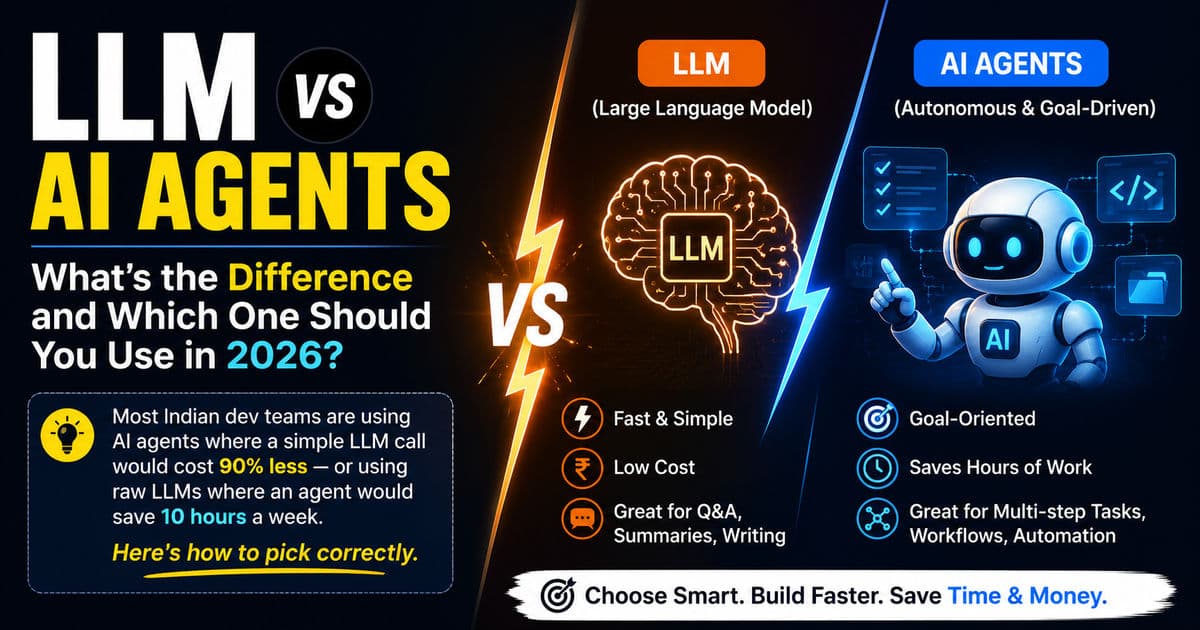
LLM vs AI Agents: What's the Difference and Which One Should You Use in 2026?
I watch Indian startups make the same mistake in two opposite directions every week. A founder spends ₹15,000/month on an AI coding agent to write blog posts — a task a single LLM API call handles for ₹0.50. Another founder tries to automate their entire deployment pipeline by copy-pasting context into ChatGPT, when an AI agent with tool access could handle the whole workflow autonomously.
The difference between an LLM and an AI agent isn't academic. It's the difference between burning money on AI that over-engineers simple tasks and leaving massive productivity gains untouched because you're under-engineering complex ones.
Here's the distinction that matters, without the jargon.
The Core Difference (In One Sentence Each)
An LLM takes your prompt, generates text, and stops. It's a prediction engine — brilliantly good at understanding language, generating content, answering questions, and reasoning through problems. But it's fundamentally reactive. You ask, it answers, the interaction ends.
An AI agent uses an LLM as its brain, then wraps it with tools, memory, planning, and autonomy so it can actually do things in the real world. It reads your database, creates a GitHub PR, runs your tests, sends a Slack message, and comes back to report what it found — all from a single instruction.
The LLM is the thinker. The agent is the doer. Most of the confusion in 2026 comes from the fact that the same products (Claude, ChatGPT, Gemini) can operate as both — depending on how you use them.
Architecture: What's Actually Different Under the Hood
When you call an LLM through an API — say, sending a prompt to Claude's /v1/messages endpoint — the model processes your input, generates a response, and that's the complete interaction. There's no memory of previous calls (unless you send conversation history), no ability to access external systems, and no capacity for autonomous decision-making. The model exists entirely within the boundary of "text in, text out."
An AI agent adds four architectural layers on top of that LLM core.
Planning is the ability to break a goal into steps. When you tell Claude Code "refactor the authentication module to use JWT instead of sessions," the agent doesn't just generate code. It reads the existing codebase, identifies which files need changes, determines the order of modifications, plans the migration path, and executes each step sequentially.
Tool use connects the agent to external systems. Through protocols like MCP (Model Context Protocol) and function calling, the agent can query databases, read files, make API calls, run terminal commands, interact with GitHub, read Figma designs, execute Playwright tests — essentially any system with an API becomes accessible.
Memory gives the agent persistent context across interactions. Claude Tag in Slack learns how your team operates over weeks and months. Cursor's agent mode remembers your project structure across sessions. This accumulated context makes the agent more effective over time, unlike a raw LLM call that starts fresh every time.
Autonomy is the agent's ability to make decisions and take actions without human intervention at every step. An agent can decide which tool to use, how to handle an error, whether to retry a failed operation, and when to ask for human approval versus proceeding independently.
Strip away any of these four layers and you're back to an LLM. Keep all four and you have an agent. Most AI products in 2026 sit somewhere on the spectrum between pure LLM and fully autonomous agent.
Real Products, Clearly Classified
Here's where the confusion clears up. Every AI product you use falls somewhere on this spectrum, and knowing where it sits tells you how to use it effectively.
Pure LLM interactions happen when you open Claude.ai and type "write me a product description for a SaaS billing platform." The model generates text. No tools accessed, no autonomous actions taken, no persistent memory beyond the current conversation. This is also what happens when you call the Claude or GPT API with a simple prompt — you get text back.
LLM with tools is what happens when Claude.ai searches the web to answer your question, or when you use ChatGPT with Code Interpreter to analyse a CSV. The model can access specific tools, but it's still operating within a single interaction — it doesn't plan multi-step workflows or act autonomously.
Light agent is where Cursor's agent mode and VS Code Copilot operate. They read your codebase (tool use), understand your project structure (limited memory), and can make multi-file edits (planning). But they operate within your editor, require your approval for most actions, and don't persist between sessions in a meaningful way.
Full agent is what Claude Code, Claude Tag, and Devin represent. Claude Code reads your entire repository, plans a multi-step refactoring, runs shell commands, executes tests, commits changes, and creates PRs — potentially running for hours without human intervention. Claude Tag lives in your Slack, monitors conversations, schedules tasks, investigates incidents, and learns your team's patterns over months.
When to Use a Raw LLM (And Save 90% of Your AI Spend)
Here's my honest take: most AI tasks in an Indian SMB don't need an agent. They need a well-prompted LLM call.
Content generation — blog posts, product descriptions, email drafts, social media copy. A single API call to Claude Sonnet costs ₹0.50-₹5 depending on length. Running an agent for this is like hiring a delivery truck to carry a letter.
Translation and localisation — converting English content to Hindi, Tamil, Marathi for your Indian audience. The LLM handles this in one call. No tools needed, no memory required, no autonomous planning necessary.
Summarisation and extraction — condensing long documents, extracting key data from reports, generating meeting summaries from transcripts. One prompt, one response, done.
Question answering — internal FAQ bots, customer support first responses, knowledge base queries (with RAG for grounding). The LLM generates the answer; no multi-step execution is needed.
Code explanation and review — understanding unfamiliar code, getting explanations of algorithms, reviewing a single file for bugs. The LLM reads the code you paste and responds.
For an Indian startup with 50 customer support queries per day, routing these through a simple LLM API call with RAG might cost ₹200-₹500/day. Setting up an agent with tool access, memory, and autonomous action capabilities for the same task could cost ₹2,000-₹5,000/day — and the answers won't be meaningfully better for straightforward queries.
When an Agent Is the Only Right Answer
Agents earn their cost when the task requires touching multiple systems, making sequential decisions, and executing actions — not just generating text.
Codebase-wide refactoring is the clearest example. Renaming a function across 40 files, updating all call sites, running the test suite, and fixing any failures is a multi-step workflow that requires file system access, terminal commands, test execution, and error handling. Claude Code handles this autonomously. A raw LLM would generate code snippets you'd have to manually apply, test, and fix yourself.
Incident response is where agents genuinely shine. When your monitoring fires an alert, an agent in your Slack (like Claude Tag) can pull error logs from Sentry, check recent deploys on GitHub, identify the problematic commit, tag the author, suggest a fix, create a PR, and monitor the recovery — all from a single alert trigger. A raw LLM can't access any of these systems.
Automated testing pipelines benefit from agents because the workflow spans multiple tools: read the API spec, generate test cases, execute them against the staging environment through Playwright or Postman, capture failures, and report results. Each step depends on the output of the previous one.
Multi-system workflows in business operations — like processing an incoming order that requires checking inventory in one system, updating CRM in another, sending confirmation email through a third, and updating accounting in a fourth — are inherently agentic. The LLM provides the reasoning; the agent provides the execution across systems.
Long-running development tasks where you want the AI to work independently for hours — building an entire feature, implementing a design from Figma, or resolving a backlog of GitHub issues — require agent autonomy. You give the instruction, the agent plans and executes, and you review the output.
The Cost Math That Nobody Does
Here's the calculation every Indian CTO and tech lead should run before choosing between LLM and agent.
A simple LLM API call with Sonnet 5 costs roughly $3 per million input tokens and $15 per million output tokens. A typical content generation task uses maybe 2,000 input tokens and 1,000 output tokens — total cost: about $0.02 (₹1.70).
An agent task with Claude Code or Cursor's agent mode using Opus 4.8 involves significantly more tokens because the agent reads files, plans steps, makes tool calls, processes results, and generates responses at each step. A moderate coding task might consume 200,000 input tokens and 40,000 output tokens — total cost: roughly $2.00 (₹170). A complex multi-file refactoring could run $5-$15 (₹425-₹1,275).
The question isn't which is cheaper — it's which matches the task. Spending ₹170 on an agent task that saves a developer 2 hours of work (valued at ₹500-₹1,000 at Indian market rates) is an excellent ROI. Spending ₹170 on an agent task that a ₹1.70 LLM call handles identically is a 100x waste.
The Decision Framework for Indian Teams
After working with dozens of Indian SMBs integrating AI into their workflows, here's the framework I use.
Use a raw LLM when the task starts and ends with text generation. No external systems need to be accessed. No state needs to persist between calls. A human will act on the output, not the AI. If the task can be described as "generate [thing] from [input]" — it's an LLM task.
Use an agent when the task requires multiple steps across multiple systems. The AI needs to read from and write to external tools. The workflow benefits from autonomous decision-making. The task would require significant human coordination if done manually.
Use both when you need the cost efficiency of LLM calls for routine work combined with agent capabilities for complex workflows. This is the pattern most mature AI implementations follow — route simple queries to a lightweight LLM call and escalate complex, multi-step tasks to a full agent.
The 2026 Reality: The Line Is Blurring
Here's what makes this conversation nuanced in 2026: the products themselves are increasingly hybrid. Claude.ai can act as a pure LLM for simple prompts and as a light agent when it uses tools. Cursor switches between autocomplete (LLM) and agent mode (full agent) depending on the task. Claude Tag operates as a persistent agent in Slack but uses standard LLM reasoning at its core.
The distinction isn't about choosing one product over another — it's about understanding which mode of interaction is appropriate for each task. The developer who uses Claude Code's full agent capabilities for every task is overspending. The developer who only uses raw API calls and manually copies context between tools is under-leveraging.
The sweet spot is intentional mode selection: LLM for text tasks, agent for execution tasks, and the intelligence to know which is which.
What You Should Do This Week
If you're running an Indian development team or startup, here are three concrete steps.
First, audit your current AI usage. List every task you're using AI for and classify it: does this task require accessing external systems and executing multi-step workflows? If no, it's an LLM task — route it through a simple API call and stop overpaying.
Second, identify your highest-value agent opportunity. Look for the workflow that currently requires the most human coordination across multiple tools — deployment pipelines, customer onboarding processes, incident response workflows. That's where an agent will deliver the most ROI.
Third, start building with the right layer. For LLM tasks, the Claude or OpenAI API with a simple wrapper is all you need — no framework, no orchestration, no agent infrastructure. For agent tasks, start with Claude Code for development workflows or explore the Claude Agent SDK for custom automation. Match the tool to the task, not the hype.
The AI industry wants you to believe everything needs an agent. Your budget knows better. Build the right thing at the right layer, and you'll get more out of AI than teams spending ten times more.
Published by APXTECK — AI-powered solutions for Indian developers and SMBs. Need help deciding between LLM integration and agent architecture for your product? Visit apxteck.com/services.
Article Comments
You must be signed in to post comments.
Sign In to Join the Discussion →No comments approved yet. Be the first to share your thoughts!
About the Author

Praveen Kumar
Co-Founder & DirectorFull-Stack Developer, APXTECK
Praveen Kumar is the Co-Founder and Full-Stack Developer at APXTECK, an AI-powered IT agency helping Indian SMBs grow through web development, automation, and AI integration. He builds production-grade systems using Node.js, Next.js, PostgreSQL, and modern AI APIs. When he is not shipping code, he is writing about practical technology that actually works for Indian businesses.
Related Insights

Meta's Brain-to-Text AI Works. The Real Question Is Who Controls It.

Grok 4.5 Is Not the Best AI Model. It Might Be the Smartest Bet.

Google's 8 Free AI Tools That Replace Your Entire Paid Stack

The Complete UI/UX Design Guide for Businesses in 2026: Improve User Experience and Increase Conversions

Next.js vs React: Which Framework Is Better for High-Performance Websites in 2026?

Why Your Business Needs a Custom Web Application to Scale in 2026

Cloud PCs for Indian Developers: Is Neverinstall Worth It?