


Meta's Brain-to-Text AI Works. The Real Question Is Who Controls It.

Praveen Kumar
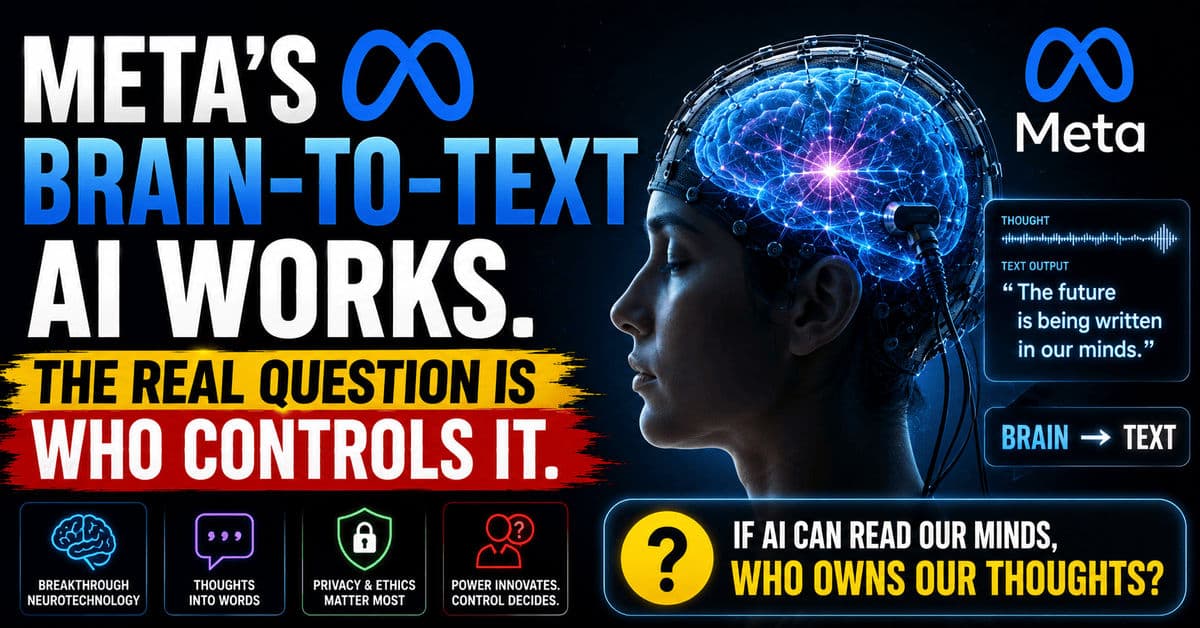
Meta's Brain-to-Text AI Works. The Real Question Is Who Controls It.
On June 29, 2026, Meta's FAIR research team in Paris published something that would have been science fiction five years ago: an AI system that reads magnetic fields from outside your skull and reconstructs the sentences you're trying to type. No surgery. No implants. No wires penetrating brain tissue. Just a helmet-shaped scanner and a deep learning pipeline.
The system is called Brain2Qwerty v2. It hit 61% average word accuracy across nine volunteers — with the best participant reaching 78%, where more than half their decoded sentences contained one word error or fewer. Previous non-invasive brain-to-text methods managed roughly 8%.
That's not a marginal improvement. That's a categorical leap. And the implications for how humans will interact with technology — including the software we build — are enormous.
How Brain2Qwerty Actually Works (Without the Sci-Fi Spin)
Let's strip away the hype and look at the engineering. Brain2Qwerty v2 uses magnetoencephalography (MEG), which measures the tiny magnetic fields generated by neurons firing inside your brain. The volunteer wears a helmet-shaped MEG scanner while typing memorised sentences on a standard QWERTY keyboard.
The AI pipeline has three layers working in sequence. First, a convolutional module extracts spatial and temporal features from the raw MEG signals — essentially identifying which brain regions are firing and when. Second, a transformer module processes those signal sequences to capture patterns and dependencies. Third, a fine-tuned language model corrects and refines the output, using semantic context to bridge the gap between noisy neural signals and coherent sentences.
The training data came from approximately 22,000 sentences typed by nine volunteers, each scanned for about 10 hours. The critical architectural leap from v1 to v2 is that the system no longer needs to know the exact timing of each keypress. V1 required external keystroke timing data to function. V2 generates sentences directly from a continuous stream of brain recordings — which theoretically means it could process brain signals without the user physically typing at all.
That last point is what makes the research community nervous and excited in equal measure.
The Numbers YouTube Gets Wrong
Most coverage of Brain2Qwerty frames it as "Meta matches Neuralink without surgery." That's misleading to the point of being wrong.
Here's the actual competitive landscape of brain-computer interfaces in mid-2026:
| System | Method | Word Accuracy | Risk | Status |
|---|---|---|---|---|
| UC Davis/BrainGate (invasive) | Implanted electrodes | ~99% | Brain surgery | Clinical use (ALS patient) |
| Neuralink N1 | Implanted chip (1,024 electrodes) | 95%+ (cursor/typing tasks) | Brain surgery | Human trials (10+ patients) |
| Brain2Qwerty v2 (Meta) | External MEG scanner | 61% avg / 78% best | Zero surgical risk | Research only (9 volunteers) |
| Previous non-invasive methods | Various | ~8% | None | Research |
Meta's achievement is extraordinary within the non-invasive category — jumping from 8% to 61% is a genuine breakthrough. But it's not matching invasive systems. A UC Davis study published in Nature Medicine in June 2026 showed an ALS patient using an invasive BCI at home with 99% word accuracy, independently, for nearly two years. Neuralink participants have demonstrated cursor control and web browsing at 95%+ accuracy.
The honest framing: Meta achieved the highest-performing non-invasive brain-to-text system ever built, narrowing the gap with surgical approaches significantly. That's a real milestone. But the gap still exists.
Why Every Major Tech Billionaire Is Betting on Brain Tech
The investment pattern tells a story that's bigger than any single company. Here's who's funding what:
Elon Musk's Neuralink raised $650 million at a $9 billion valuation in June 2025, pursuing invasive brain implants with robotic surgical insertion. Sam Altman co-founded Merge Labs, which emerged from stealth in January 2026 with $252 million in funding at an $850 million valuation, pursuing non-invasive ultrasound-based brain-computer interfaces. OpenAI led the round. Jeff Bezos and Bill Gates both backed Synchron through Bezos Expeditions and other vehicles — Synchron has raised $345 million for a less-invasive approach that threads electrodes through blood vessels to the brain's surface, avoiding open surgery. Peter Thiel backed Blackrock Neurotech with over $100 million.
These are not speculative bets from venture funds looking for moonshots. These are personal investments from the people who built the current tech stack, and they're converging on the same thesis: the next major computing interface will be neural.
The strategic logic is straightforward. If AI models keep getting more capable, the bottleneck shifts from "what can the software do" to "how fast can humans communicate their intent to the software." Typing is slow. Voice is faster but imprecise. Neural interfaces — if they work at scale — remove the bottleneck entirely.
What This Means for Developers (And Why You Should Care Now)
This might seem distant from building Next.js apps or PostgreSQL databases. It's not. Here's why.
The Input Layer Is Going to Change
Every application we build today assumes a specific input paradigm: keyboard, mouse, touch, voice. Brain-computer interfaces introduce a fundamentally different input layer — one where the user's intent is captured before they translate it into physical actions.
For Indian developers building accessibility features, health-tech platforms, or communication tools, BCI is not a 2040 technology. Brain2Qwerty v2's training code is open-source. The v1 dataset is publicly available through Meta's Digital Brain Project. The architecture — convolutional feature extraction, transformer sequence modelling, language model refinement — uses the exact same building blocks we already work with.
The API Layer Will Follow
Every major human-computer interface shift has created a new API ecosystem. Touchscreens created gesture APIs. Voice created speech-to-text APIs. BCIs will create neural-intent APIs. The companies investing billions today are building the infrastructure that developers will integrate against tomorrow.
If you're an Indian developer or startup founder planning your product roadmap for the next 3-5 years, awareness of this shift isn't optional. You don't need to build BCI products today, but you need to architect systems that can accommodate new input modalities without a full rewrite.
The Open-Source Signal
Meta open-sourced Brain2Qwerty's training code and is funding the $5 million Digital Brain Project to release datasets and accelerate neuroscience research. This follows their playbook with LLaMA — release the research, build an ecosystem, then capture value at the platform layer. Indian research institutions and startups have a genuine window to contribute to this space before it consolidates.
The Privacy Problem Nobody Can Solve
And here's where the conversation gets uncomfortable. Meta — the company that built its entire business model on harvesting user data, that was fined $1.2 billion by the EU for data transfers, that knows your browsing habits, social connections, purchase intent, and political leanings — now wants access to your brain signals.
Let's be precise about what Brain2Qwerty reads. It decodes the motor intent to type, not your private thoughts. It reads the neural signals associated with planning finger movements on a keyboard. It cannot read your inner monologue, your memories, or your emotions. The system is not mind-reading, and framing it as such is irresponsible.
But that distinction matters less than you'd think when you consider the trajectory. V1 decoded individual characters. V2 decodes full sentences from continuous streams. V3 (or whatever comes next) will decode speech intent without typing. Each version reads a little deeper into the neural pipeline that connects thought to action.
The question isn't "can Meta read your thoughts today?" The question is: who sets the boundaries on what neural data is collected, stored, processed, and monetised as this technology matures? And what legal frameworks exist — in India, in the US, in Europe — to govern a data type that didn't exist until last month?
India's Digital Personal Data Protection Act covers "personal data" but doesn't specifically address neural data. There's no precedent for informed consent when the data source is your brain's electromagnetic field. This is a governance gap that policymakers, technologists, and ethicists need to close before the technology is ready for consumers — not after.
The Race Ahead: Surgery vs. No Surgery
The brain-computer interface industry has split into two camps, and the split mirrors a classic engineering trade-off: accuracy versus accessibility.
The invasive camp — Neuralink, Blackrock Neurotech, parts of BrainGate — gets direct electrical access to neurons. The signal is cleaner, the accuracy is higher, and the results for paralysed patients are genuinely life-changing. The cost is brain surgery, with all its risks: infection, electrode degradation, scar tissue formation, and the simple reality that most people will never voluntarily let a robot drill into their skull.
The non-invasive camp — Meta, Merge Labs, various academic groups — reads signals from outside. The accuracy is lower, the signal is noisier, but the barrier to adoption is essentially zero. No surgery. No recovery time. No risk of hardware failure inside your brain.
Brain2Qwerty v2's significance is that it proves the non-invasive approach can get meaningfully close to useful accuracy levels. Going from 8% to 61% (and 78% for the best participant) in a few years suggests the trajectory is steep. If accuracy continues improving at this rate — and that's a meaningful "if" — non-invasive BCIs could reach clinical utility within this decade.
The Honest Limitations
Before you get swept up in the excitement, here's what Brain2Qwerty cannot do today.
It requires a room-sized MEG scanner that costs millions of rupees. This is not a wearable headband you'll buy on Amazon. It's a research instrument found in neuroscience labs, and shrinking it to consumer form factor is an unsolved engineering problem.
It was tested on nine healthy volunteers, not patients. People with ALS, stroke damage, or other neurological conditions — the populations who would benefit most — may produce fundamentally different neural signals. The system hasn't been validated on them.
The 61% average accuracy means roughly 4 out of every 10 words are wrong. That's useful for research but not for reliable daily communication. The 78% best-case figure is more promising, but it represents one participant out of nine.
The training requires 10 hours of scanning per person. That's not a quick calibration — it's a significant time investment that limits practical deployment.
What This Means for Indian Tech
For Indian healthtech startups, the opportunity is in building the software layer around BCI hardware as it matures — assistive communication apps, clinical monitoring interfaces, rehabilitation tools. The hardware will come from Meta, Neuralink, and Synchron. The software that makes it useful for Indian patients, in Indian languages, within Indian healthcare infrastructure — that's where Indian developers can create real value.
For Indian AI researchers, Meta's open-sourced code and datasets represent a genuine opportunity to contribute to a field that's still early enough for new entrants to matter. IITs and IISc research groups working on signal processing, transformer architectures, or neural decoding have a direct on-ramp.
For everyone else: pay attention. The way humans interact with computers is going to change fundamentally in the next decade. The keyboard, the touchscreen, the voice assistant — these are all intermediaries between your intention and the machine's action. The race to eliminate that intermediary is now funded, staffed, and producing real results.
The technology works. The question is no longer "can we do this?" It's "who controls it, who profits from it, and who makes sure it serves the people who need it most?"
Published by APXTECK — AI-powered solutions for Indian developers and businesses. Exploring how emerging tech intersects with real-world product development? Visit apxteck.com/contact.
Article Comments
You must be signed in to post comments.
Sign In to Join the Discussion →No comments approved yet. Be the first to share your thoughts!
About the Author

Praveen Kumar
Co-Founder & DirectorFull-Stack Developer, APXTECK
Praveen Kumar is the Co-Founder and Full-Stack Developer at APXTECK, an AI-powered IT agency helping Indian SMBs grow through web development, automation, and AI integration. He builds production-grade systems using Node.js, Next.js, PostgreSQL, and modern AI APIs. When he is not shipping code, he is writing about practical technology that actually works for Indian businesses.
Related Insights

LLM vs AI Agents: What's the Difference and Which One Should You Use in 2026?

Grok 4.5 Is Not the Best AI Model. It Might Be the Smartest Bet.

Google's 8 Free AI Tools That Replace Your Entire Paid Stack

The Complete UI/UX Design Guide for Businesses in 2026: Improve User Experience and Increase Conversions

Next.js vs React: Which Framework Is Better for High-Performance Websites in 2026?

Why Your Business Needs a Custom Web Application to Scale in 2026

Cloud PCs for Indian Developers: Is Neverinstall Worth It?