


BitChat and Bluetooth Mesh: What Delhi's Internet Shutdown Proved

Praveen Kumar
BitChat and Bluetooth Mesh: What Delhi's Internet Shutdown Proved
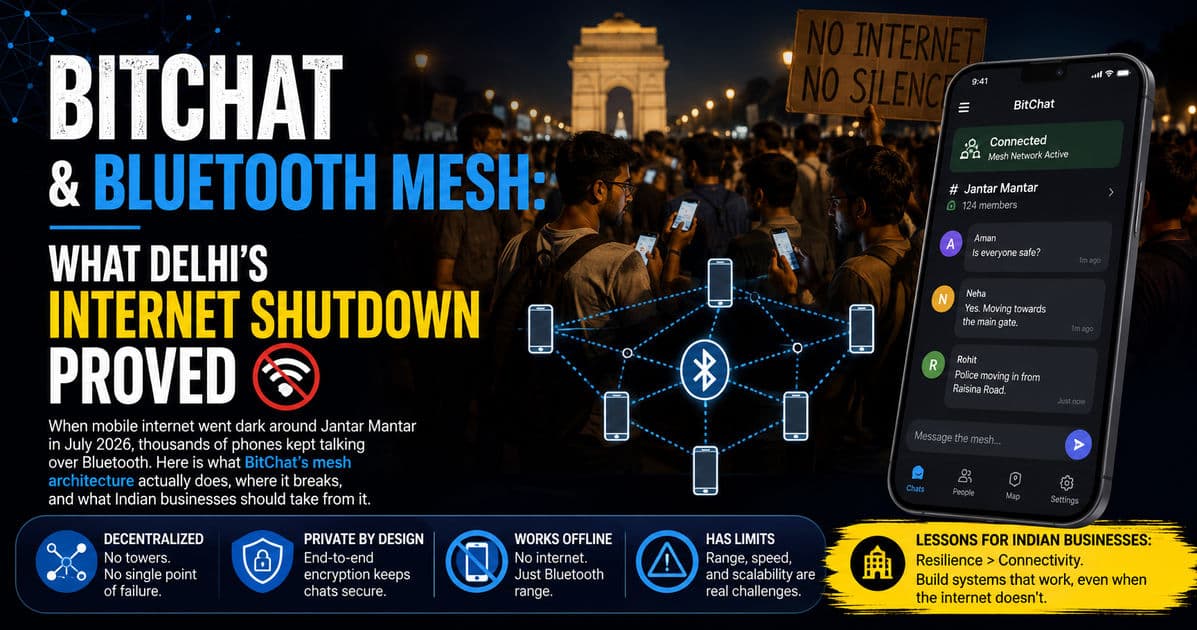
On the night of 21 July 2026, mobile internet stopped working across a few hundred metres of central Delhi. Walk to Patel Chowk, roughly a kilometre away, and your phone worked fine. Inside the perimeter, nothing loaded. Within hours, a Bluetooth mesh messaging app most Indian developers had filed away as a 2025 novelty was suddenly the most consequential piece of software in the country.
If you build software for a living in India, the interesting part of that story is not the politics. It is the engineering claim underneath it: that a phone-to-phone radio mesh, with no servers, no SIM, and no account, can carry usable traffic when the network layer everyone depends on simply stops existing. That claim deserves a hard technical look rather than a viral one — because the same architecture pattern is relevant to any business whose revenue stops when the internet does.
What BitChat Actually Is Under the Hood
BitChat came out of a weekend project by Jack Dorsey in July 2025, built with Block's AI coding assistant. It is a peer-to-peer messenger that runs over Bluetooth Low Energy instead of cell towers or Wi-Fi. No phone number, no email, no account registration, no central server to subpoena or block.
The mesh, in plain terms
Every phone running the app is simultaneously a client and a relay. When you send a message, it does not travel to a server and back. It goes to whichever devices are physically within Bluetooth range, and each of those devices re-broadcasts it to its own neighbours. A time-to-live counter decrements at every hop and the packet dies when it hits zero — seven hops in BitChat's case. Each node keeps a Bloom filter of message IDs it has already seen, so a packet that has been through a device once gets dropped rather than echoing around the mesh forever.
That is the whole trick. It is gossip protocol design, not magic. The clever part is that it turns crowd density — normally a problem for networks — into the transport itself. The denser the crowd, the better the mesh performs.
When any node in the mesh does have internet, the app can optionally bridge to the Nostr protocol so local clusters reach the wider world. That bridge is a bonus, not a dependency. Cut it and the mesh still runs.
What Actually Happened in Delhi in July 2026
The sequence matters, because it is the closest thing to a real-world stress test this architecture has had in India.
Mobile internet around the Jantar Mantar protest site was suspended from the night of 21 July, with reports of network jammers deployed nearby. Demonstrators shifted to offline mesh apps — mainly BitChat, with Briar and Bridgefy also in use — to stay in contact within the crowd. On 22 July, Delhi Police were reported to be investigating the Bluetooth messaging apps in use.
On 23 July, the Indian Cyber Crime Coordination Centre under the Ministry of Home Affairs issued takedown notices: GitHub was directed to disable the BitChat repository, Google to pull BitChat, Briar and Bridgefy from the Play Store, and Apple to remove BitChat and Bridgefy. Intermediaries were given three hours to comply. The following day, officials orally instructed them not to enforce the directions.
The technically instructive detail is what the takedown could not touch. BitChat's Android code is MIT-licensed and the iOS code is public domain. By that point the repository had been forked over two thousand times. Removing three URLs from one host does not remove software that has already been copied into thousands of independent repositories and sideloaded onto phones. This is the same lesson the Streisand effect teaches, but expressed in version control: distribution and source availability are architectural properties, and you cannot patch them out with a notice.
Delhi was also not the first instance. BitChat download spikes had already tracked protest events in Indonesia, Nepal, Iran, Madagascar and Uganda through 2025 and early 2026, and Apple pulled it from the China App Store in April 2026.
The Honest Verdict: Where BitChat Falls Short
Here is where I part ways with most of the coverage. BitChat is an interesting proof of concept with genuine reach problems and unresolved security questions. Treating it as a solved communications layer is wrong, and the app's own maintainers have said as much.
| Popular claim | Engineering reality |
|---|---|
| Works anywhere without internet | Works only where enough users run it nearby. One hop is roughly 10–30 m indoors, up to 100 m outdoors in good conditions. Sparse areas mean messages never find a path out. |
| Seven hops means long range | Seven hops of BLE realistically covers a few hundred metres end to end. It is a crowd-scale network, not a city-scale one. |
| End-to-end encrypted, so it is safe | Researchers including Alex Radocea have flagged weak identity authentication enabling impersonation, and limited forward secrecy. Dorsey added a repository warning that the app has had no professional security audit. |
| Messages get delivered | Early builds shipped without delivery confirmation. You do not know a message arrived unless the recipient answers through another channel. |
| Open source means trustworthy downloads | Permissive licensing also permits malicious forks. A donation-soliciting fake clone appeared during Iran's blackout. Sideloading during a shutdown is exactly when signature verification is hardest. |
| Bluetooth cannot be blocked | BLE can be jammed, and the mesh can be flooded with junk traffic. Neither requires sophisticated equipment. |
Add the boring constraints: text only as of mid-2026, no voice, images or file transfer over the mesh layer, and continuous BLE scanning and relaying is a meaningful battery draw on a phone you may not be able to charge.
How the alternatives compare
| App | Transport | Platforms | Practical strength | Practical weakness |
|---|---|---|---|---|
| BitChat | BLE mesh, optional Nostr bridge | iOS, Android | No account, fully open source, large fork base | No formal audit, density-dependent, text only |
| Bridgefy | BLE mesh | iOS, Android | Largest install base, longest track record | Ads in free tier, past security criticism |
| Briar | Tor, Wi-Fi, Bluetooth | Android | Strongest privacy design of the group | In maintenance mode, Android only |
| Meshtastic | LoRa radio hardware | Device plus app | Kilometre-scale range, not phone-density dependent | Requires buying hardware, roughly ₹2,500–₹6,000 per node |
If your actual requirement is resilient communication across distance rather than within a crowd, LoRa hardware beats phone Bluetooth every time. That is an unglamorous answer, which is why it gets less coverage.
Why Indian SMBs Should Care About Offline-First Architecture
Strip out the protest context and a plain operational fact remains: connectivity in India is not a constant, and any system you build that assumes it is will fail on a schedule you do not control.
SFLC.in recorded 60 internet shutdowns in India during 2024, adding up to roughly 3,160 hours of disruption, with Top10VPN putting the economic cost at around $322 million — close to ₹2,700 crore. Five of those were region-wide shutdowns during examinations. That last category matters for SMBs: exam-related shutdowns are scheduled, predictable events that take out UPI, card terminals, cloud POS and delivery apps for hours across an entire district.
If you run a retail chain in Jaipur, a clinic in Indore or a logistics operation in Guwahati, this is a business continuity problem, not a civil liberties one. Your billing software should not stop billing because a district administration issued an order.
| Business function | Common failure mode | Offline-tolerant approach |
|---|---|---|
| Point of sale | Cloud POS returns errors, staff fall back to paper | Local-first storage in the browser or app, queued sync on reconnect |
| Payments | UPI and card terminals both dead | RBI offline payment modes for small-value transactions, plus recorded cash fallback |
| Order intake | WhatsApp Business API unreachable | SMS and IVR fallback path with the same order schema |
| Staff coordination | Group chat unavailable across a site | On-premise Wi-Fi with a local server, or a mesh app for short range |
| Reporting | Nothing reaches head office | Timestamped local ledger with conflict-resolved sync |
Local-first is a design decision, not a feature
Most Indian SMB software I audit treats the network as infallible. Every action is a round trip. Lose the connection and the interface either spins or throws an error at a customer standing at the counter.
The fix is architectural and it is not exotic. Write to local storage first, treat the server as an eventual destination rather than a gatekeeper, give every record a client-generated ID and a timestamp so replays are idempotent, and define a conflict resolution rule before you need one. A progressive web app with IndexedDB and a sync queue gets a small retailer most of the way there. The engineering cost is a few days of design work at the start of the project and close to nothing if retrofitted early.
Design your degradation ladder deliberately
Every business-critical workflow should have a written fallback chain: primary path, degraded path, manual path. Order intake might run WhatsApp API first, SMS second, phone call third — with all three feeding the same data structure so nothing needs re-keying afterwards. Most teams have this chain informally, in the heads of two long-serving staff members. Write it down, test it once a quarter, and it becomes an operational asset instead of tribal knowledge.
What To Do This Week
Pick your single highest-revenue workflow and disconnect it. Turn off Wi-Fi and mobile data on the device your staff actually use, then attempt a complete transaction. Note precisely where it breaks and how long recovery takes once connectivity returns. That one exercise will tell you more about your resilience than any vendor SLA document.
Then decide honestly whether mesh messaging belongs in your plan at all. For most Indian businesses it does not — you need offline-tolerant transactions and a tested SMS fallback, not a Bluetooth chat app. BitChat is a genuinely interesting piece of network engineering and a poor substitute for local-first design. Build the boring thing first.
At APXTECK we build offline-tolerant web platforms and automation systems for Indian SMBs — local-first data layers, queued sync, and fallback paths that hold when connectivity does not. If your current stack fails the disconnect test above, talk to us.
Published by APXTECK — practical engineering for Indian businesses, without the fluff. apxteck.com/services
Article Comments
You must be signed in to post comments.
Sign In to Join the Discussion →No comments approved yet. Be the first to share your thoughts!
About the Author

Praveen Kumar
Co-Founder & DirectorFull-Stack Developer, APXTECK, chatgpt, google
Praveen Kumar is the Co-Founder and Full-Stack Developer at APXTECK, an AI-powered IT agency helping Indian SMBs grow through web development, automation, and AI integration. He builds production-grade systems using Node.js, Next.js, PostgreSQL, and modern AI APIs. When he is not shipping code, he is writing about practical technology that actually works for Indian businesses.
Related Insights

The CEO's Playbook: Leading Digital Transformation in Manufacturing

Why Gujarat's Top Brands Partner with a Digital Transformation Agency

Maximize Digital Marketing ROI With Custom Software

How Micro-Animations in Custom Designs Turn Visitors into Buyers

Secret Psychology Behind High-Converting Coaching Interfaces

How Node.js Development Empowers SMBs in Maharashtra

The SMB Guide to Scaling Down Enterprise Tech on a Budget