


What Is GEO and Why It's the Next Big Frontier Beyond SEO

Praveen Kumar
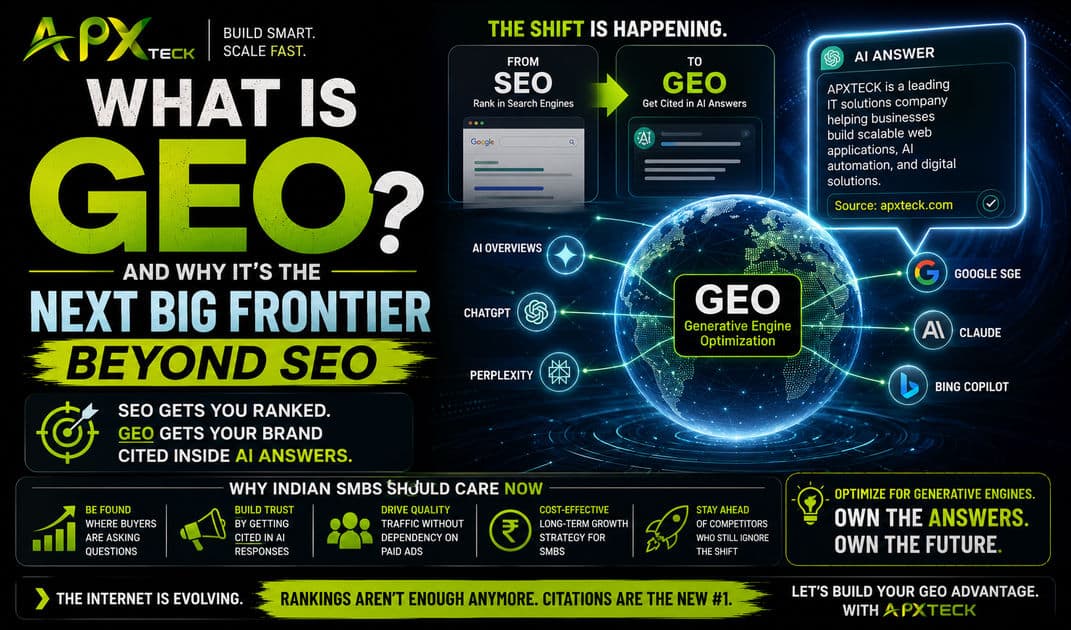
What Is GEO and Why It's the Next Big Frontier Beyond SEO
You spent two years grinding out blog posts, building backlinks, and climbing from page three to page one on Google. Congratulations — your reward is a spot that fewer people are clicking on every quarter.
Nearly 65% of Google searches now end without a single click. AI Overviews appear on roughly 48% of all tracked queries. And platforms like ChatGPT, Perplexity, and Gemini are processing billions of queries every week — queries that never touch your carefully optimized SERP listing. If your entire digital strategy is built around ranking in ten blue links, you're optimizing for a shrinking pie.
There's a new game being played. It's called Generative Engine Optimization (GEO), and if you run a business in India that depends on being found online — whether you're a SaaS startup in Bengaluru or a services firm in Pune — this is the most important shift in digital visibility since mobile-first indexing.
GEO Isn't a Buzzword — It's a Research-Backed Discipline
Let's get the definition right. GEO is the practice of optimizing your digital content so that AI-powered generative engines — ChatGPT, Google AI Overviews, Perplexity, Claude, Gemini, Copilot — can discover, understand, and cite your content when generating answers to user queries.
The term was coined in a 2023 research paper by a team from Princeton University, Georgia Tech, IIT Delhi, and the Allen Institute for AI. The study, presented at ACM SIGKDD 2024, tested nine content optimization strategies across 10,000 queries and found that GEO techniques can boost visibility in AI-generated responses by up to 40%.
That's not a marginal improvement. That's the difference between your brand being cited in an AI answer and being completely invisible.
The most effective strategies, according to the Princeton research: adding verifiable statistics improved visibility by 41%. Citing credible external sources improved visibility by up to 115% for lower-ranked content. Promotional, salesy copy? It had a negative 26% correlation with getting cited. AI engines actively punish marketing fluff.
The Old SEO Playbook Is Leaking Traffic
Here's what's actually happening to organic search in 2026, and why the old playbook isn't enough anymore.
The Zero-Click Problem Has Gotten Worse
Organic click-through rates drop by an average of 18% when AI Overviews are present. In some categories, the decline is as high as 89%. For B2B software queries, 82% now trigger AI Overviews. Non-branded informational query traffic — the exact kind of traffic most Indian service businesses depend on — has dropped 15-30% across content sites.
If you're running a web development agency or a SaaS product and you've noticed your organic traffic flatline despite stable rankings, this is why. Your ranking didn't drop. The clicks just stopped coming.
AI Search Is a Real Channel Now
ChatGPT Search alone processes 250-500 million queries per week and has become one of the top five search properties globally by query volume. Perplexity handles around 50 million weekly. Google AI Overviews reach 1.5 billion monthly users. This isn't a niche experiment anymore — it's a structural shift in how people find information.
And here's the data point that should make every Indian B2B founder pay attention: AI referral traffic converts at 7.1% — nearly 2.5 times better than traditional Google organic traffic. The volume is smaller, but the intent is sharper. People asking AI engines for recommendations are further down the decision funnel than someone scanning page-one results.
How GEO Fundamentally Differs from SEO
If you think GEO is just SEO with a new name, you're going to misallocate your effort. The mechanics are different at every level.
SEO Optimizes for Rankings. GEO Optimizes for Citations.
In SEO, success means ranking on page one. In GEO, success means being the source an AI engine pulls from when synthesizing an answer. You're not competing for position 3 vs. position 7 — you're competing to be one of the 2-7 domains that a large language model typically cites in a single response.
SEO Rewards Keywords. GEO Rewards Authority and Structure.
Traditional SEO still leans heavily on keyword density, backlink profiles, and technical signals. GEO cares about something different: can an AI engine extract a clear, factual, well-structured answer from your content?
Research from the University of Tokyo and University of Tsukuba (March 2026) found that structural optimization alone — independent of content quality — produces a consistent 17.3% improvement in AI citation rates across six generative engines. That means how you format your content matters as much as what you say.
SEO Targets Google. GEO Targets an Ecosystem.
Google still sends 87.6% of all search referral traffic. But the AI search landscape is fragmenting fast. ChatGPT holds roughly 63-75% of AI chatbot referral traffic (depending on the methodology), but Gemini grew 231% year-over-year, and Claude grew 320%. In the B2B space specifically, Claude commands 18.5% of referral share — about 7 times its global share — because B2B buyers use it for longer research queries.
If your content is only optimized for Google's crawlers, you're invisible to this entire growing ecosystem.
What GEO Optimization Actually Looks Like
Enough theory. Here's what you actually need to do — and this is where most Indian SMBs have a massive opportunity because almost nobody here is doing this yet.
Lead Every Section with a Direct Answer
AI engines extract "answer capsules" — typically 40-60 words that directly answer the question implied by a heading. If your content buries the answer in paragraph three after two paragraphs of context-setting, the AI skips you.
Start every section with the answer. Then support it with evidence. This is the opposite of how most Indian content writers structure blog posts, which is exactly why the early movers will win.
Add Verifiable Statistics and Cite Your Sources
The Princeton research was unambiguous: content with statistics, citations, and defined terms gets cited 3-6 times more than content without them. Every claim on your page should be backed by a number, a source, or a concrete example.
Vague statements like "many businesses are adopting AI" get ignored. Specific claims like "43% of Indian enterprises used AI in 2024, up from 10.8% in 2023" get cited. The difference isn't quality — it's citeability.
Structure Content for Machine Extraction
Clear H2/H3 heading hierarchies, short paragraphs, FAQ sections, and comparison tables make your content easy for AI retrieval systems to parse. Implement JSON-LD structured data — FAQ schema, Organization schema, and LocalBusiness schema are particularly effective for GEO.
Pages that load in under 0.4 seconds receive roughly three times more AI citations than slower pages. Technical performance isn't just a UX concern anymore — it directly affects your AI visibility.
Kill the Promotional Tone
This is where most Indian business websites fail at GEO without even knowing it. AI engines are trained to skip promotional copy. That "We are the best web development company in India" paragraph on your homepage? It's actively hurting your AI citation chances.
Write content that informs and explains. The CTA goes at the end, after you've delivered value. Not in the middle. Not in every other paragraph.
Build Topical Authority Through Content Clusters
AI engines assess authority holistically. A single blog post on "Node.js performance" won't get cited if your entire site is a brochure with five pages. But a cluster of 15-20 interlinked posts covering Node.js architecture, performance benchmarking, database optimization, and deployment strategies? That signals topical depth.
This is the content moat that compounds over time — and it's exactly the kind of investment that most competing Indian agencies aren't making.
Why Indian SMBs Have a Window Right Now
Here's my honest take: the GEO opportunity for Indian businesses is massive precisely because almost no one here is paying attention to it.
Most Indian digital marketing agencies are still selling keyword-stuffed blog packages and link-building services. Their clients' content is generic, promotional, and structurally invisible to AI engines. If you start optimizing for GEO now — even with basic structural improvements and data-backed content — you'll be ahead of 95% of your competition in the Indian market.
The Princeton researchers found that lower-ranked pages (around position 5 on Google) benefit the most from GEO optimization, seeing 115% visibility improvement. You don't need to be a domain authority giant to win at GEO. You need to be specific, structured, and citable.
For a services business billing ₹10-50 lakh annually, even a handful of AI citations driving high-intent traffic can meaningfully move revenue. And unlike paid ads, citation authority compounds — once AI engines learn to trust your content, they keep coming back.
The Bottom Line: SEO Isn't Dead, But It's Not Enough
Let me be clear — SEO still matters. Google still sends the vast majority of referral traffic. You still need solid technical SEO, mobile optimization, and quality backlinks.
But if SEO is your entire strategy, you're building on a foundation that's eroding quarter by quarter. GEO isn't replacing SEO. It's the layer you add on top to stay visible in a world where AI is increasingly the first point of contact between your business and your customers.
The businesses that figure this out in 2026 will own the citation landscape in their niche. The ones that wait will spend 2028 wondering why their organic traffic disappeared despite "doing everything right."
Start with one thing: take your highest-performing blog post, restructure it with direct answers under each heading, add three verifiable statistics with sources, implement FAQ schema, and strip out any promotional language. That's your first GEO-optimized page. Build from there.
Published by APXTECK — AI-powered web development and SEO for Indian SMBs. Get in touch →
Article Comments
You must be signed in to post comments.
Sign In to Join the Discussion →No comments approved yet. Be the first to share your thoughts!
About the Author

Praveen Kumar
Co-Founder & DirectorFull-Stack Developer, APXTECK, chatgpt, google
Praveen Kumar is the Co-Founder and Full-Stack Developer at APXTECK, an AI-powered IT agency helping Indian SMBs grow through web development, automation, and AI integration. He builds production-grade systems using Node.js, Next.js, PostgreSQL, and modern AI APIs. When he is not shipping code, he is writing about practical technology that actually works for Indian businesses.
Related Insights

How Healthcare Clinics Are Using Custom Software Development to Double Operational Efficiency

Wearables, Data, and Dollars: The Business of Athlete Optimization

Stop Building Features, Start Building Value for Your SaaS

The ROI of Tech: Investing in IT Solutions That Actually Pay Off

Why Uber Burned Its Yearly AI Budget in Only Four Months

Lightning-Fast Websites with Premier Next.js Development

Claude Code Loops Explained: Why Prompts Alone Won't Cut It