


Wearables, Data, and Dollars: The Business of Athlete Optimization

Praveen Kumar
Wearables, Data, and Dollars: The Business of Athlete Optimization
A single Formula 1 car generates up to 1.5 terabytes of data per race weekend from over 300 onboard sensors streaming more than a million data points per second. An NBA team using Catapult wearables tracks every player's acceleration, deceleration, change of direction, and cumulative physical load across every minute of every practice and game. A WHOOP study monitoring 119 NCAA Division I athletes showed a 60% reduction in injuries for athletes who acted on their wearable data.
These aren't science experiments. They're operational systems generating measurable competitive advantage — and they represent the early innings of a market that's reshaping how athletes train, recover, compete, and generate revenue.
The global AI in sports market was valued at $3.60 billion in 2025 and is projected to reach $37.66 billion by 2034, growing at 27.5% CAGR. The GPS player tracking systems market alone is on track to grow from $1.6 billion in 2026 to $5.2 billion by 2036. These numbers reflect a fundamental shift: athlete optimization is no longer a luxury for elite teams. It's becoming the standard operating model for every serious sports organization, fitness brand, and sports academy worldwide.
This post breaks down the technology stack, the business model, and the real opportunities — for sports organizations, fitness companies, coaches, and the technology teams building the platforms underneath.
What Athlete Optimization Actually Means
Athlete optimization is the systematic use of data, technology, and analytics to maximise an athlete's performance while minimising injury risk and recovery time. It goes beyond traditional coaching intuition by adding objective, measurable, real-time data to every decision — from how hard an athlete trains on Tuesday to whether they should play on Saturday.
The concept matters because the margins in professional sport are razor-thin. The difference between a championship team and a mid-table finish often comes down to injuries, fatigue management, and marginal performance gains that compound over a season. A team that keeps its best players available for 90% of matches instead of 70% gains a measurable competitive edge that translates directly into wins, revenue, and franchise value.
The Data Athletes Generate
Modern athlete monitoring captures an extraordinary range of biometric and performance signals. GPS and accelerometer data tracks position, speed, distance, acceleration, and deceleration patterns. Heart rate monitors and HRV (heart rate variability) sensors measure cardiovascular stress and recovery status. Sleep trackers capture sleep duration, quality, REM cycles, and circadian patterns. VO₂ max estimations from wearable sensors indicate aerobic capacity trends. Movement sensors measure biomechanical patterns — joint angles, stride mechanics, and force distribution. Emerging sensors track hydration levels, blood oxygen saturation, skin temperature, and even sweat composition.
Each of these data streams, individually, provides limited insight. Combined through AI and machine learning, they create a comprehensive picture of an athlete's readiness, risk, and performance trajectory that was impossible to achieve even five years ago.
The Wearable Technology Stack
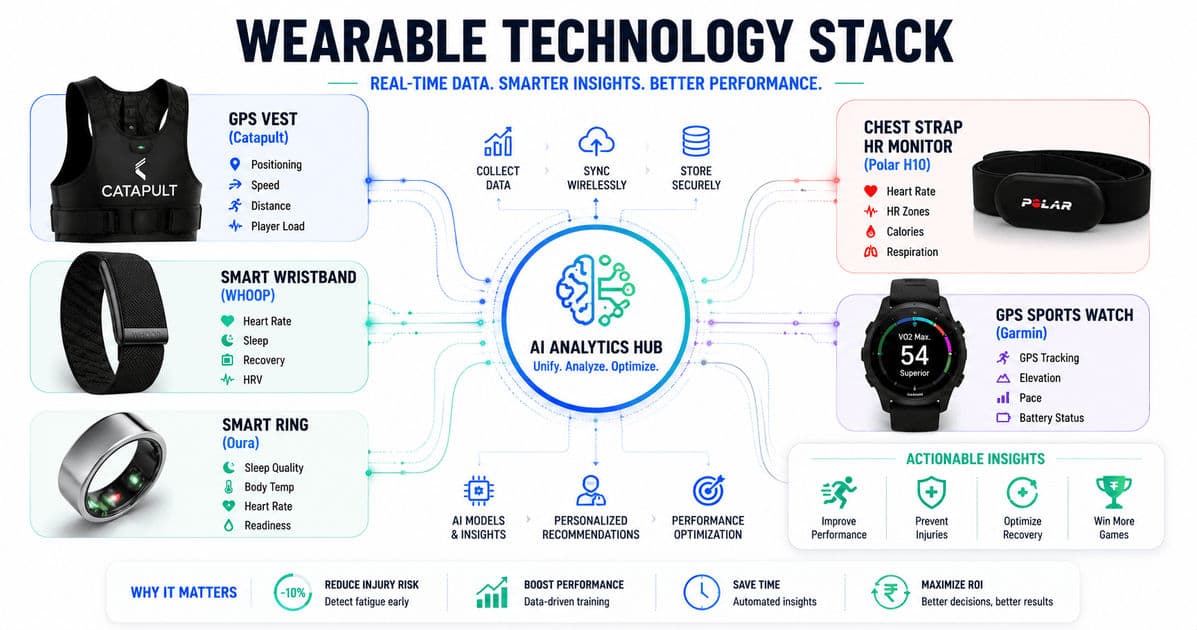
The hardware layer of athlete optimization has matured rapidly. Several categories of devices now form the foundation of modern sports science.
GPS and Inertial Measurement Units
Catapult Sports is the global leader in this category, providing wearable GPS and IMU (inertial measurement unit) devices to over 5,000 teams globally, including teams across the NFL, NBA, and English Premier League. Their Vector devices measure player load — a proprietary metric combining tri-axial accelerometer data — along with speed, distance, and positioning. Elite team contracts average around $100,000 per year, while their sub-elite Catapult One product runs at $180 per player annually.
STATSports is a primary competitor, particularly strong in European football, with clients including the Brazil national team, Manchester City, and Liverpool FC. Their Apex Pro device provides similar GPS and accelerometer data with real-time live streaming to coaching tablets.
Recovery and Readiness Wearables
WHOOP has built a subscription-based wearable business ($30/month) around continuous heart rate, HRV, skin temperature, and blood oxygen monitoring. Their platform focuses on strain (daily exertion), recovery (readiness to perform), and sleep quality. WHOOP's data from NCAA Division I athletes demonstrated a 60% reduction in injuries when athletes and coaches acted on the wearable's recovery recommendations.
Oura Ring takes a minimalist approach — a smart ring that tracks sleep stages, heart rate, HRV, body temperature, and activity. Its appeal in sports comes from its unobtrusive form factor: athletes can wear it 24/7 including during sleep, generating continuous data without the discomfort of a wristband or chest strap.
Garmin and Polar serve both consumer and professional markets with multi-sport GPS watches that track everything from running dynamics and cycling power to swimming metrics and altitude training data.
How AI and Machine Learning Transform Raw Data
Collecting data is the easy part. The value — and the competitive moat — is in what you do with it.
Predictive Injury Analytics
This is where machine learning has the most direct, measurable impact on sports business outcomes. The core insight is simple: non-contact injuries (hamstring strains, ACL tears from fatigue, stress fractures) correlate with workload patterns that are detectable in wearable data days before the injury occurs.
The key metric is the Acute-to-Chronic Workload Ratio (ACWR) — the ratio of an athlete's recent training load (typically last 7 days) to their longer-term average (typically last 28 days). Research published in Frontiers in Sports and Active Living shows that athletes whose ACWR exceeds 1.6 are 1.5 times more likely to suffer soft-tissue injuries. Machine learning models trained on historical workload and injury data can flag athletes entering this danger zone before symptoms appear.
The Golden State Warriors famously rested key players during the 2014-15 regular season based on Catapult data showing multiple players in overload zones — a decision that was unpopular at the time but contributed to their NBA championship run against a fatigued Cleveland Cavaliers team.
Computer Vision for Biomechanical Analysis
AI-powered video analysis has moved beyond basic replay into sophisticated biomechanical assessment. Computer vision models can now analyse an athlete's movement patterns from standard video footage — identifying gait asymmetries, inefficient mechanics, or compensatory movements that indicate developing problems.
FIFA has integrated this technology into its match analysis systems, while cricket boards in India and Australia use computer vision to analyse bowling actions and batting mechanics at granular levels that human coaches simply cannot perceive in real time.
Real-Time Decision Support
During live competition, AI systems process streaming sensor data to provide coaching staff with actionable intelligence. In the NFL, real-time player tracking via Zebra RFID sensors embedded in shoulder pads provides instantaneous position and speed data for every player on the field. Coaching staff can see fatigue patterns developing during a game and adjust substitution timing accordingly.
In Formula 1, this concept reaches its extreme: teams run real-time predictive models on trackside micro-datacentres that process over a million sensor data points per second. These models forecast tire degradation curves, optimal pit stop windows, and strategy adjustments based on live conditions. McLaren runs Dell portable data centres at the track to update their car's digital twin in real time. Ferrari has achieved up to 60% faster CFD simulations using Amazon SageMaker for component testing.
The Business Value: Why This Is a Revenue Story
Athlete optimization isn't just a performance story. It's a business case with quantifiable returns.
Injury Cost Reduction
A single major injury to a star player can cost a professional sports team millions in salary for a non-performing asset, reduced competitiveness, lower ticket and merchandise revenue, and decreased franchise valuation. Wearable-driven injury prevention that reduces non-contact injuries by even 20-30% generates direct, measurable ROI that dwarfs the cost of the technology.
Player Valuation and Recruitment
Sports analytics platforms now inform transfer decisions worth tens of millions of dollars. AI models that combine on-field performance data with biometric profiles, injury history, and workload tolerance help clubs make better recruitment decisions — and avoid overpaying for players whose data profiles suggest elevated injury risk.
Subscription and SaaS Revenue Models
WHOOP pioneered the subscription-based wearable model: the hardware is included in a $30/month membership, creating recurring revenue rather than one-time device sales. Catapult's SaaS platform generates ongoing subscription revenue from its 5,000+ team clients. These models are replicable for any sports technology company building analytics platforms.
Content and Fan Engagement
Player biometric data is becoming broadcast content. F1's partnership with AWS generates real-time performance graphics showing tire degradation predictions and driver performance comparisons during live broadcasts. The NBA's player tracking data powers advanced statistics that drive fantasy sports engagement, betting markets, and media content — all revenue-generating applications.
Sponsorship and Data Partnerships
Wearable companies partner with leagues and teams for data access, branding, and technology validation. These partnerships generate revenue for both parties while providing the wearable company with high-profile use cases and the sports organisation with cutting-edge technology.
Challenges and Risks
The athlete optimization space has real obstacles that any organisation entering it must address.
Data Privacy and Athlete Rights
Who owns the biometric data generated by an athlete's body? This question is legally unresolved in most jurisdictions. Player unions in the NFL and NBA have negotiated specific provisions around wearable data usage — including restrictions on how data can be used in contract negotiations and requirements for player consent. European GDPR regulations add additional complexity for clubs operating in the EU.
In India, the Digital Personal Data Protection Act covers personal data broadly, but specific provisions for biometric performance data collected by sports organisations remain untested.
Accuracy and Reliability
Consumer-grade wearables are not medical devices. Heart rate accuracy varies by 5-15% depending on skin tone, device placement, and activity type. GPS accuracy degrades indoors. Sleep stage detection is approximate, not clinical. Any sports organisation building decision systems on wearable data needs to understand these accuracy limitations and calibrate their models accordingly.
Implementation Cost
Elite-level athlete monitoring systems are expensive. Catapult's enterprise contracts average $100,000/year. Building a custom analytics platform on top of wearable data requires data engineering, machine learning expertise, and ongoing maintenance. For Indian sports academies and IPL-adjacent organisations, the cost-benefit analysis must account for both the technology investment and the data science talent required to make it useful.
Ethical Considerations
Continuous biometric monitoring of employees (which professional athletes effectively are) raises legitimate ethical concerns around surveillance, autonomy, and the pressure to share personal health data. Organisations must balance the competitive advantage of data-driven optimization with respect for athlete privacy and consent.
Future Trends: Where This Is Heading
AI Coaches and Autonomous Training Systems
AI systems are moving from advisory (providing data for human coaches to interpret) to autonomous (generating and adjusting training plans independently based on real-time athlete data). Personalised training programs that adapt daily based on sleep quality, recovery status, and performance trends are already available in consumer apps and will become standard in professional settings.
Digital Twins for Athletes
The digital twin concept — creating a virtual replica that mirrors the real entity's state in real time — is moving from Formula 1 cars to human athletes. An athlete's digital twin would integrate all biometric streams, performance data, injury history, and training load into a comprehensive model that can simulate "what if" scenarios: what happens to injury risk if we increase sprint volume by 15%? What's the optimal taper strategy before a specific competition?
Edge AI and On-Device Processing
Processing biometric data on the wearable device itself (edge AI) rather than streaming it to cloud servers enables real-time feedback with zero latency and reduced privacy exposure. This trend will make real-time coaching feedback during training — alerts for form breakdown, fatigue thresholds, or dangerous workload spikes — practical and immediate.
Democratisation Through Cost Reduction
As sensor costs drop and AI models become more accessible through cloud APIs, elite-level athlete monitoring will become available to amateur sports, school athletics, and fitness consumers. The $100,000/year Catapult contract of today will become a $500/year subscription service within a decade — the same trajectory smartphones followed from enterprise to consumer.
What Sports Organisations Should Do Next
If you're running a sports organisation, fitness brand, coaching academy, or sports tech startup, here's the practical playbook.
Start with a specific, measurable problem — injury reduction is usually the highest-ROI entry point. Identify which athletes, positions, or training phases generate the most injuries, and deploy wearable monitoring targeted at those specific risk areas.
Build the data infrastructure before buying more hardware. Most sports organisations have more data than they can effectively use. The bottleneck is rarely the sensors — it's the analytics pipeline that transforms raw data into actionable coaching decisions.
Invest in the platform, not just the devices. The long-term value in sports tech is in the software layer — the AI models, the analytics dashboards, the integration with coaching workflows. Hardware commoditises. Software compounds.
And if you don't have the technical team to build this in-house, partner with an AI-focused development agency that understands both the sports domain and the underlying technology stack — data pipelines, ML model deployment, real-time analytics, and scalable cloud infrastructure.
Published by APXTECK — AI-powered IT solutions for sports organisations, fitness brands, and tech-forward businesses. Need help building wearable data integrations, predictive analytics platforms, or custom AI-powered sports dashboards? Visit apxteck.com/services.
Article Comments
You must be signed in to post comments.
Sign In to Join the Discussion →No comments approved yet. Be the first to share your thoughts!
About the Author

Praveen Kumar
Co-Founder & DirectorFull-Stack Developer, APXTECK
Praveen Kumar is the Co-Founder and Full-Stack Developer at APXTECK, an AI-powered IT agency helping Indian SMBs grow through web development, automation, and AI integration. He builds production-grade systems using Node.js, Next.js, PostgreSQL, and modern AI APIs. When he is not shipping code, he is writing about practical technology that actually works for Indian businesses.
Related Insights

What Is GEO and Why It's the Next Big Frontier Beyond SEO

Stop Building Features, Start Building Value for Your SaaS

The ROI of Tech: Investing in IT Solutions That Actually Pay Off

Why Uber Burned Its Yearly AI Budget in Only Four Months

Lightning-Fast Websites with Premier Next.js Development

Claude Code Loops Explained: Why Prompts Alone Won't Cut It

Are You Doing Dark Mode Wrong? 5 Psychological Color Mistakes Destroying Your UX