


How Healthcare Clinics Are Using Custom Software Development to Double Operational Efficiency

Praveen Kumar
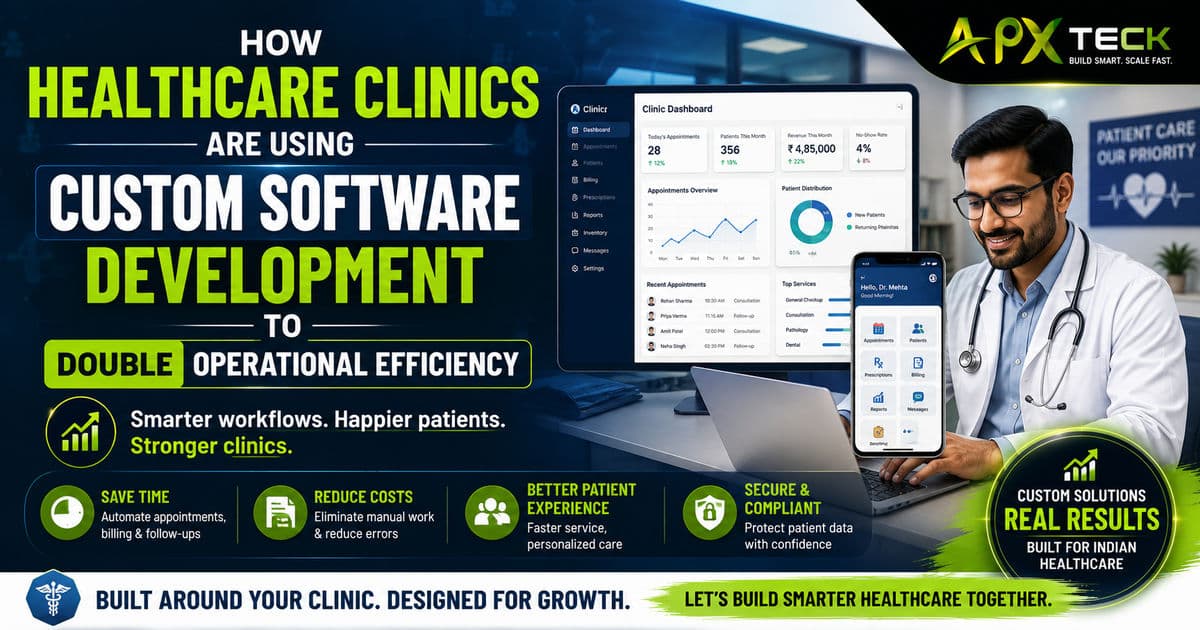
How Healthcare Clinics Are Using Custom Software Development to Double Operational Efficiency
Walk into a typical healthcare clinic and you'll often find the same problem hiding behind modern-looking reception desks: staff juggling multiple software systems, patients waiting longer than necessary, doctors searching for reports across different applications, and administrators spending hours preparing billing reports.
Most clinics don't have a healthcare problem—they have a workflow problem.
As patient volumes continue to increase across India, relying on spreadsheets, WhatsApp messages, paper records, and disconnected management software is becoming expensive. Every extra minute spent on administration is a minute that could have been spent treating another patient.
This is exactly why many healthcare clinics are investing in custom software development instead of trying to force generic hospital management software to fit their workflows. Rather than adapting their business to software limitations, they're building software around how their clinics actually operate.
The result?
Many clinics report dramatically faster operations, lower administrative costs, fewer human errors, and significantly improved patient experiences.
Let's examine how custom healthcare software is transforming clinic operations.
Why Generic Clinic Software Eventually Becomes a Bottleneck
Off-the-shelf clinic management systems promise to solve every problem.
In reality, they often solve only the common problems while introducing new ones.
Every clinic has unique workflows:
Multi-specialty clinics
Diagnostic centers
Dental clinics
IVF centers
Physiotherapy clinics
Eye hospitals
Pediatric clinics
Yet many use identical software.
That mismatch creates operational friction.
Common issues include:
Duplicate patient entries
Manual appointment confirmations
Slow billing
Poor inventory tracking
Difficult insurance processing
No integration with laboratory software
Separate accounting systems
Limited reporting capabilities
Instead of making work easier, employees spend their day moving data between different applications.
What Is Custom Healthcare Software Development?
Custom healthcare software is designed specifically around a clinic's workflow instead of forcing the clinic to change its processes.
Instead of purchasing dozens of disconnected tools, clinics can build one integrated platform that manages:
Patient registration
Doctor scheduling
Electronic Medical Records (EMR)
Billing
Pharmacy
Lab management
Inventory
Follow-up reminders
Telemedicine
AI-powered reporting
Analytics dashboards
Every module communicates with the others automatically.
No duplicate data.
No unnecessary paperwork.
No repeated data entry.
How Custom Software Doubles Operational Efficiency
Operational efficiency isn't about making employees work harder.
It's about eliminating unnecessary work.
Below are the biggest improvements clinics experience.
1. Faster Patient Registration
Reception desks become bottlenecks during peak hours.
Without automation:
Paper forms
Manual data entry
Duplicate records
Insurance verification delays
With custom software:
Digital registration
Aadhaar-enabled identity verification (where appropriate)
QR-based patient check-in
Returning patient recognition
Automatic medical history retrieval
What previously took 10–15 minutes can often be completed in just a few minutes.
2. Intelligent Appointment Management
Missed appointments cost clinics money.
Custom software can automatically:
Send SMS reminders
Send WhatsApp confirmations
Allow online rescheduling
Notify doctors of delays
Reduce scheduling conflicts
Manage multiple doctors across branches
Instead of staff making hundreds of reminder calls every week, the system handles the process automatically.
3. Electronic Medical Records Improve Doctor Productivity
Searching paper files wastes valuable consultation time.
A custom EMR system gives doctors instant access to:
Previous prescriptions
Lab reports
X-rays
Allergies
Chronic conditions
Follow-up history
Doctors spend less time searching and more time treating patients.
Operational Comparison
| Workflow | Traditional Clinic | Custom Software |
|---|---|---|
| Patient Registration | Manual | Digital & Automated |
| Appointment Booking | Phone Calls | Online + WhatsApp |
| Medical Records | Paper Files | Instant Digital Access |
| Billing | Manual Entry | Automated |
| Inventory | Excel Sheets | Real-Time Tracking |
| Reports | End-of-Day Manual | Live Dashboard |
| Follow-ups | Staff Reminder | Automated Notifications |
| Multi-Branch Operations | Separate Systems | Unified Platform |
The difference isn't just convenience—it directly impacts revenue, staff productivity, and patient satisfaction.
AI Is Becoming a Competitive Advantage for Clinics
Artificial Intelligence is no longer limited to large hospitals.
Smaller clinics are adopting practical AI features that reduce repetitive work.
Examples include:
AI Appointment Assistant
Patients can book appointments through voice or chat without speaking to reception staff.
AI Prescription Digitization
Doctors' handwritten prescriptions can be converted into searchable digital records.
AI Follow-Up Recommendations
The software identifies patients who are overdue for reviews and automatically schedules reminders.
AI Analytics
Clinic owners receive insights such as:
Peak consultation hours
Doctor utilization rates
Revenue by department
Medicine consumption trends
Patient retention rates
These insights help clinics make informed business decisions instead of relying on assumptions.
Better Inventory Means Less Waste
Medicine and medical consumables are expensive.
Many clinics discover expired inventory only during audits.
Custom inventory systems can:
Monitor stock levels in real time
Track batch numbers
Send expiry alerts
Predict future demand
Automate purchase requests
Reduce overstocking
This minimizes wastage and improves cash flow.
Centralized Billing Improves Cash Flow
Billing errors lead to delayed payments and frustrated patients.
Custom billing software can integrate:
UPI
Credit cards
Insurance claims
Laboratory charges
Pharmacy invoices
GST invoices
Outstanding balances
Every transaction is recorded automatically.
Management can view real-time revenue without waiting for manual reports.
Data Security Matters More Than Ever
Healthcare data is among the most sensitive information any organization stores.
Custom software allows clinics to implement:
Role-based access control
Multi-factor authentication
Encrypted patient records
Secure cloud backups
Audit logs
Automated backup schedules
Unlike shared generic software, security policies can be tailored to the clinic's compliance requirements and risk profile.
Build vs Buy: Which Makes More Sense?
| Factor | Generic Software | Custom Software |
|---|---|---|
| Initial Cost | Lower | Higher |
| Long-Term ROI | Moderate | High |
| Custom Workflows | Limited | Fully Custom |
| AI Integration | Rare | Flexible |
| Scalability | Limited | Excellent |
| Third-Party Integrations | Restricted | Extensive |
| Competitive Advantage | None | High |
| Ownership | Vendor Controls | Clinic Owns Solution |
For small clinics with very basic needs, off-the-shelf software may be sufficient.
However, clinics managing multiple doctors, branches, diagnostics, pharmacies, or specialized workflows often find that custom software delivers greater value over time through efficiency gains and reduced operational overhead.
Real-World Example
Imagine a multi-specialty clinic in Bengaluru handling 250 patients daily.
Before implementing custom software:
Three receptionists manually entered patient details.
Doctors frequently waited for physical files.
Billing required manual verification.
Follow-up reminders were inconsistent.
Inventory audits took several days each month.
After implementing a unified custom platform:
Patients completed digital registration before arrival.
Doctors accessed records instantly.
Bills were generated automatically.
Follow-up reminders were sent via WhatsApp and SMS.
Inventory levels were updated in real time.
Management viewed daily performance through live dashboards.
The clinic reduced administrative workload, improved appointment flow, and enabled staff to focus more on patient care instead of repetitive paperwork.
Choosing the Right Development Partner
Healthcare software is more than just another business application.
Your technology partner should understand:
Healthcare workflows
Secure API integrations
Scalable backend architecture
Cloud deployment
Database optimization
Performance monitoring
Security best practices
AI integration opportunities
A well-designed platform should continue evolving with your clinic as patient expectations, regulations, and technologies change.
The Future Belongs to Digitally Efficient Clinics
The most successful clinics over the next decade won't necessarily be the ones with the biggest buildings or the most expensive equipment.
They'll be the ones that remove operational friction.
Every automated appointment, every instantly accessible medical record, every real-time dashboard, and every AI-assisted workflow frees healthcare professionals to spend more time where it matters most—with patients.
Custom software development is no longer just an IT investment. It's an operational strategy that can improve efficiency, reduce administrative costs, enhance patient experiences, and create a stronger foundation for long-term growth.
If your clinic is still managing operations through disconnected tools and manual processes, start by mapping your current workflow, identifying repetitive tasks, and prioritizing the areas where automation can deliver measurable results. The biggest efficiency gains often come from solving the simplest operational bottlenecks first.
Published by APXTECK — Building AI-powered software, automation platforms, and scalable web solutions for growing businesses. Explore our services at apxteck.com/services
Article Comments
You must be signed in to post comments.
Sign In to Join the Discussion →No comments approved yet. Be the first to share your thoughts!
About the Author

Praveen Kumar
Co-Founder & DirectorFull-Stack Developer, APXTECK
Praveen Kumar is the Co-Founder and Full-Stack Developer at APXTECK, an AI-powered IT agency helping Indian SMBs grow through web development, automation, and AI integration. He builds production-grade systems using Node.js, Next.js, PostgreSQL, and modern AI APIs. When he is not shipping code, he is writing about practical technology that actually works for Indian businesses.
Related Insights

What Is GEO and Why It's the Next Big Frontier Beyond SEO
Wearables, Data, and Dollars: The Business of Athlete Optimization

Stop Building Features, Start Building Value for Your SaaS

The ROI of Tech: Investing in IT Solutions That Actually Pay Off

Why Uber Burned Its Yearly AI Budget in Only Four Months

Lightning-Fast Websites with Premier Next.js Development

Claude Code Loops Explained: Why Prompts Alone Won't Cut It